


By Joy Donovan
Photography by Thanin Viriyaki
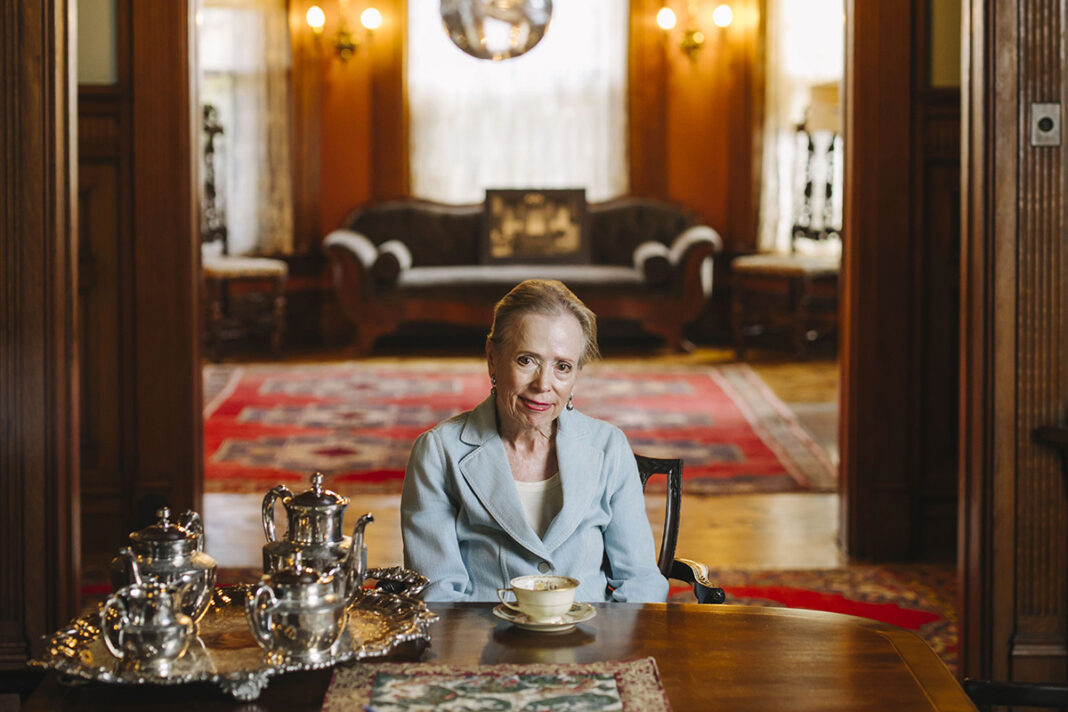
In her second-floor office, Jerre Tracy, executive director of Historic Fort Worth, looks out over her beloved Fort Worth skyline she’s spent her career fighting to protect. Her petite frame is nearly swallowed by the soaring historic ceilings of McFarland House, the headquarters of Historic Fort Worth, an organization she has led for a quarter century.
Here, in this 1899 showpiece located on the edge of downtown, she literally sits atop an example of what the nonprofit does to protect her hometown’s legacy. Tracy now is a recognized force in preservation circles, and she works ensconced in the kind of landmark her mission is designed to save. It’s a daily reminder of the Cowtown legacy she’s determined to keep standing.
“I really do love Fort Worth,” she says, with her characteristic smile. “It’s got charm. I think it’s a town that people can raise a family in and be glad they were here.”
For the past 25 years, she’s led Historic Fort Worth, an organization determined to preserve buildings others might have been quick to assign to a wrecking ball. The nonprofit, founded in 1969, has served as a positive force in the city’s preservation initiatives through stewardship and education. Through this mission-based group, Tracy has led others to champion Fort Worth’s architectural character and historic identity.
She’s earned respect for what she has done to ensure Fort Worth does not become “generica America,” as she likes to say. The smiling blonde with genteel southern manners might appear to be a gentle flower, but underestimating her strength would be a mistake. She’s more the proverbial steel magnolia — a Southern woman with refined grit and elegant fortitude. Whether through gentle persuasion, verbal advocacy or elegant resolve, Tracy has literally fought city hall when necessary… although she’s sure to have tried other ideas first.
Tracy’s “dogged determination” is one of her strengths, according to Randi Thistlethwaite, a Historic Fort Worth board member.
“She’s a good leader, encouraging advocacy and preservation,” Thistlethwaite says of Tracy. “She is very knowledgeable and has taught many board members. Preservation can be hard to wrap your head around, but she clarifies it for the board members.”
Buildings, architecture and construction are practically in Tracy’s DNA. A fourth-generation Fort Worth resident, Tracy grew up watching construction, hearing about architecture and admiring bridges since her family established North Texas Steel Company in 1909.
After graduating from Paschal High School and spending a short time at Texas Christian University, she majored in education at the University of Texas before marrying her husband, David, whom she had dated in high school and who eventually became an attorney.
After teaching for a time, she became a stay-at-home mother for their daughter and son.
“It’s been a journey,” she says, reflecting on her path to becoming a preservation professional. “When I look back, everything I did is tied back to the built family. That’s what the men in my family were doing.”
As a girl, she was surrounded by people always talking about buildings, and she absorbed it all. Her father was in construction, and her brother was an engineer.
“I’m not the engineering type, but art and things about Fort Worth very much interest me,” she says.
As a Fort Worth native, she remains well connected, especially in the “build community” where her family was rooted. Joining Chi Omega at UT, she possesses the gracious charm of a sorority girl. Serving on multiple Junior League committees, she is educated in how Fort Worth works and got a taste of preservation through Junior League volunteer work, interestingly enough, when the Junior League was headquartered in the same building. And now, after leading Historic Fort Worth, she is accomplished at rescuing tradition-rich structures.
Protecting historic properties is at the forefront of the nonprofit’s work, and its list of threatened buildings to save and preserve is long. Among the varied projects Tracy is proud to have rescued are not only McFarland House, but also the Stockyards, bridges over Trinity River, Knights of Pythias Hall, Swift & Co. office building, Ridglea Theater, Forest Park Gates, Thistle Hill mansion, Heritage Park Plaza and the Tarrant County Medical Society building.
Many have been officially landmarked, giving the sites legal protection and safeguarding them from demolition.
Conversely, other endeavors end in heartbreak, the most recent example being the Fort Worth Convention Center Arena. The futuristic spaceship-designed structure where Elvis Presley, Bob Dylan, Cher, and Elton John once performed will be imploded, along with decades of memories, to make way for a new exhibit center and ballroom. Tracy takes these losses seriously, if not personally.
“It’s been in every flyover in this city because it’s so distinct,” she says of the “flying saucer” designed by a consortium of architects in the 1960s. Historic Fort Worth patrons had hoped the mid-century could be adapted for a new use, saving the iconic architecture. “It’s a shame. We’ll never get it back. It’s gone forever.”
This property, along with more than 150 others, has appeared on Historic Fort Worth’s annual “Most Endangered Places” list. The official registry, which rallies preservationists to act before a site is lost, is just one of the activities Tracy spearheads each year.
Educational programs, tours, restoration guidance, research, public appeals, and, of course, like most nonprofits, fundraising are among Historic Fort Worth’s many activities.
Not only does Tracy talk the talk, but she also walks the walk. She prizes the city’s many unique neighborhoods with diverse yet charming characteristics. She has “landmarked” her own home on Colonial Parkway and encourages others to do the same to keep neighborhoods “cohesive.” As an educator, she sees great value in teaching history in schools.
“As a teacher, I’m very sure that our youth would love to do a historical survey,” she says. “We wait too long to put history in the hands of others.”
Her job — probably more of a passion — keeps her working five or six days a week. She unwinds by cooking, traveling, and playing her grandmother role, but Historic Fort Worth often needs her attention. She seems to thrive through the running board meetings, navigating public affairs and handling projects.
“It’s never boring,” she says with her characteristic smile. “It’s never dull. You never know where preservation is going to take you.” She pauses and smiles again. “It’s a city I love.”