

By Rachael Lindley
Photography by Crystal Wise
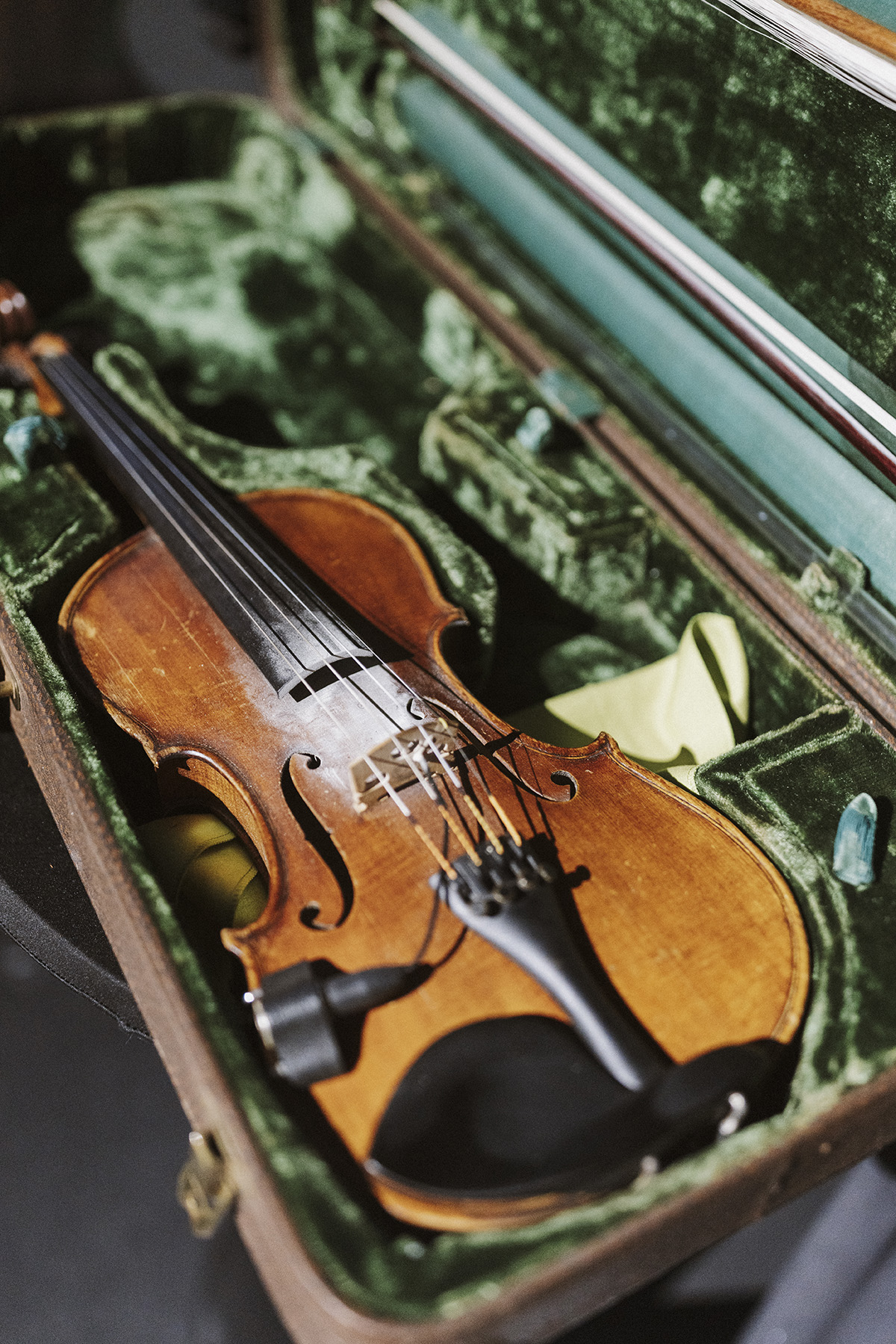
Around 1930, at a Fort Worth house party, a young fiddler named Bob Wills met a jazz-leaning vocalist named Milton Brown. When Brown asked Wills if he knew Bessie Smith’s “St. Louis Blues,” Wills didn’t just say yes — he confessed he’d once ridden a mule 40 miles just to hear her play. That encounter didn’t just spark a partnership; it fused rural fiddle tunes, African American blues, and big-band charisma into a restless new genre that could only have been born in North Texas: Western swing.
Iconic Western actor Barry Corbin compares the genre to a gumbo — or the Texas equivalent, Charlie Goodnight’s son-of-a-bitch stew. Western swing combines sounds from different origins, all rolled into one.
“They took everything American and threw it all together, stirred it up so you couldn’t tell what was in it,” Corbin laughs. “Then they added horns, drums, and that made Western swing essentially American music.”
“It is an amalgamation,” says Mike Markwardt, whose years-long fascination with the music eventually led him to create a documentary chronicling its history.
Another description may be even more evocative: “cowboy jazz” — cowboys with stringed instruments playing with the complexity, improvisation, and rhythmic swagger of jazz.
And while Western swing would eventually travel from Texas to Oklahoma, California, and far beyond, an important chapter of its story unfolded right here in Fort Worth.
A Sound At The Crossroads
Long before Wills became synonymous with Western swing, he was a boy playing ranch dances around Turkey, Texas, alongside his father. Wills began performing at the gatherings by age 10, absorbing musical influences that extended far beyond traditional country fiddle tunes. Growing up in the cotton country of West Texas exposed him to Black musical traditions, while time spent in New Mexico introduced another important influence: Mexican music.
When Wills arrived in Fort Worth around the end of the 1920s, all of those influences came with him.
Following their meeting, Wills and Brown would regularly retreat to the second floor of Fort Worth’s Ed Kimball Furniture Store, where Brown introduced Wills to records and musicians he had been listening to. Wills, already familiar with the blues, became enthralled with the soulful sound. Their musical repertoire began absorbing even more influences.
This was not country music as Nashville would eventually define it.
Wills himself resisted the “hillbilly” label. His response was essentially the opposite: This was jazz. This was blues. This was American music.
Music Made For Moving
The music developed with the dance floor in mind. It swung. It bounced. It invited couples to two-step, turn, and twirl. Eventually, drums, amplified guitars, steel guitar, and even horn sections would make the sound bigger and more sophisticated, but its essential purpose remained remarkably simple: Get people out of their chairs.
Western swing arrived during the Great Depression and Dust Bowl, when families across Texas and Oklahoma were living through extraordinary hardship. Dance halls offered an escape, however temporary.
“Everybody loved it because they needed something to lift their spirits at the time,” says Andrea Ruby, great-granddaughter of Bob Wills.
Wills, Brown, and their bandmates were giving people a reason to hit the dance floor at a moment when they desperately needed an escape. The music spread quickly because it offered light in a dark era.
Radio helped carry that momentum further. By 1931, Wills and Brown were performing as part of the Light Crust Doughboys, broadcasting live on Fort Worth radio station KFJZ. Their sponsor, flour businessman W. Lee “Pappy” O’Daniel, preferred wholesome songs about home, religion, and America. The musicians were interested in something considerably broader.
Eventually, Brown and Wills both moved on. Brown left first and formed the Musical Brownies, creating an extraordinarily sophisticated band. Wills relocated to Tulsa, where he formed the Texas Playboys and continued expanding the sound.
Then came another piece of the puzzle — electricity.
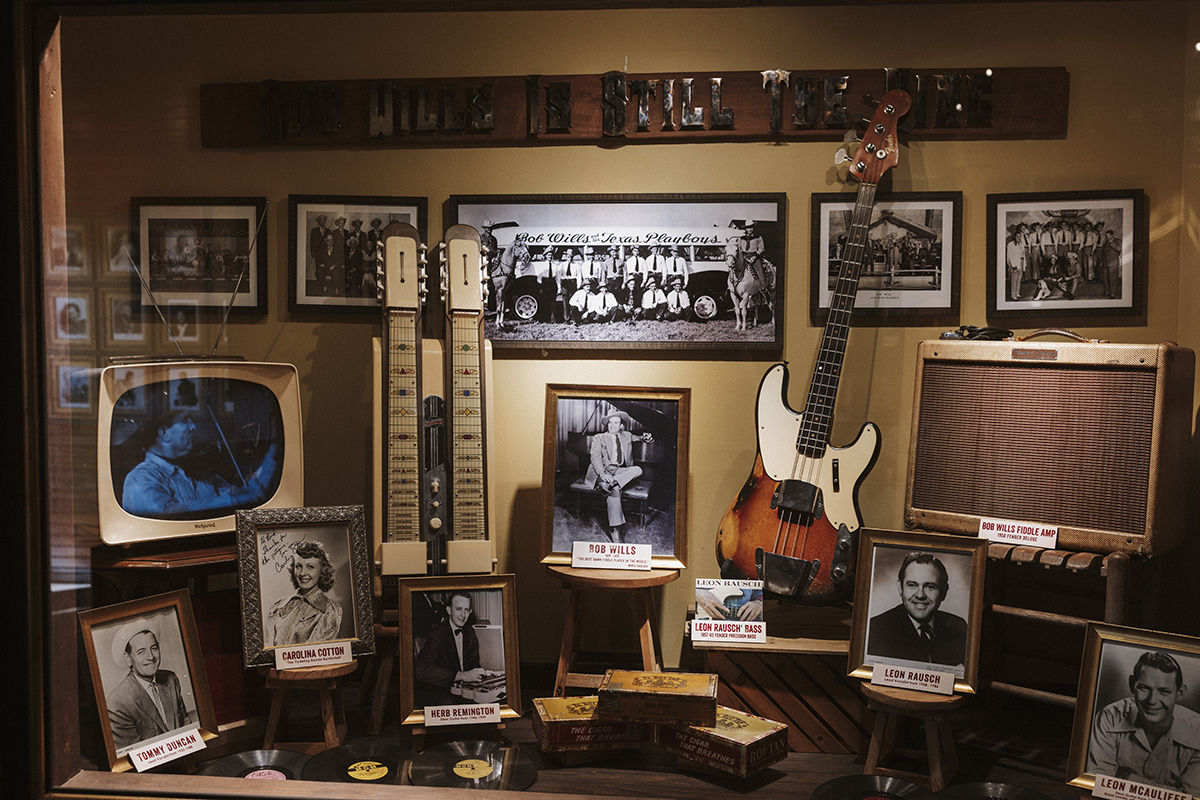
In 1934, Brown’s Musical Brownies recorded with steel guitarist Bob Dunn, whose amplified instrument introduced a startling new sound. The group had an early performance at Crystal Springs Dance Hall in which dancers stopped to listen, stunned by what they were hearing. The amplified steel guitar would become one of the defining sounds not only of Western swing but of country music itself.
Wills added drums, much to the dismay of the Grand Ole Opry, which at the time didn’t allow them. Electric guitars became increasingly important. Then came trumpets, saxophones, and clarinets. By the 1940s, the Texas Playboys could swell to nearly 20 musicians, capable of moving from fiddle tunes to arrangements that evoked the great swing orchestras of Benny Goodman and Tommy Dorsey.
The cowboy string band had become comparable to a big band.

An American Family Tree
That evolution is one reason Western swing becomes difficult to contain within the boundaries of “country.” It is much more than that, with its musical descendants stretching in multiple directions.
Honky-tonk absorbed its influence. So did the Bakersfield sound. Some even argue that Western swing belongs in the story of rockabilly and early rock ’n’ roll — a connection that has received far less attention than the influence of Delta blues. Texas country artists including Ernest Tubb and Lefty Frizzell emerged in a musical world profoundly shaped by Wills.
Yet for all that influence, the story of Western swing can sometimes feel strangely absent from the broader American music narrative. That absence is partly what compelled Fort Worth local, Mike Markwardt to begin documenting it.
“So I thought I got to right that wrong,” Markwardt recalls. “And so I said I’ll make a film.”
What sounded simple became a years-long undertaking involving travel to roughly 10 cities and interviews with some 30 people. He hopes the documentary, The Birth & History of Western Swing, will make its debut in 2027. The result connects the story’s pioneers to the musicians keeping its language alive today.
The Swing Comes Back Around
Western swing has always moved in cycles. After World War II, enormous ensembles became difficult to sustain. Bands shrank, the music changed, and new genres moved into the spotlight. But Western swing never disappeared.
Wills believed the genre would periodically fade only to return again, claiming its “groove beat” was fundamentally designed for danceability — a timeless formula that cycles back into favor like clockwork.
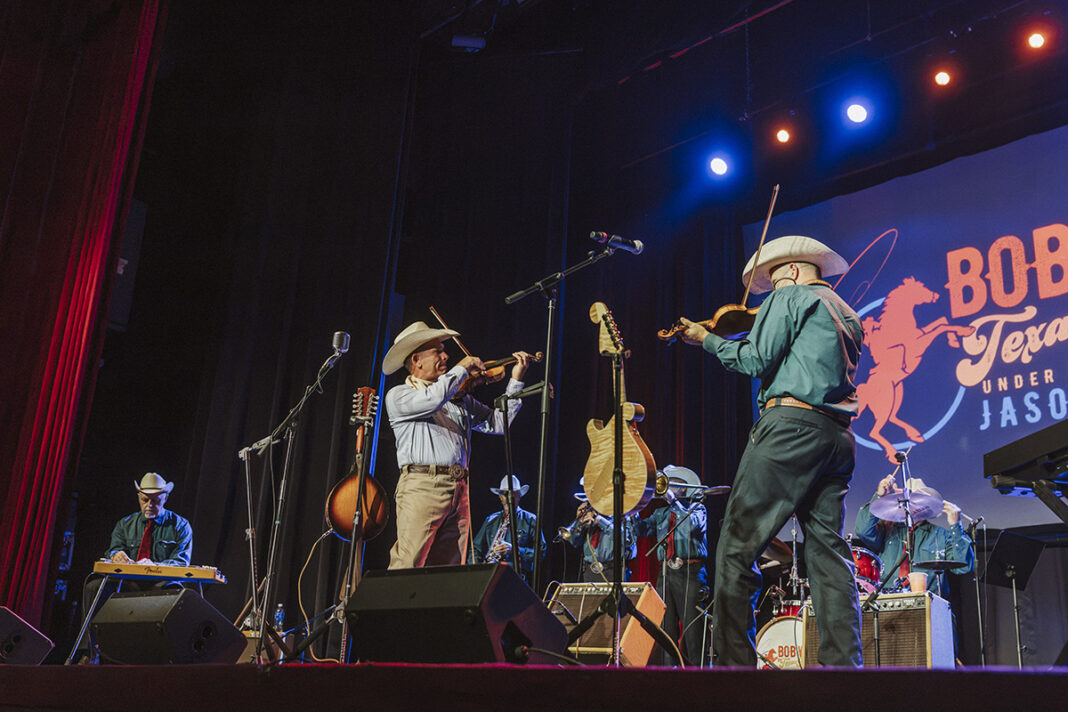
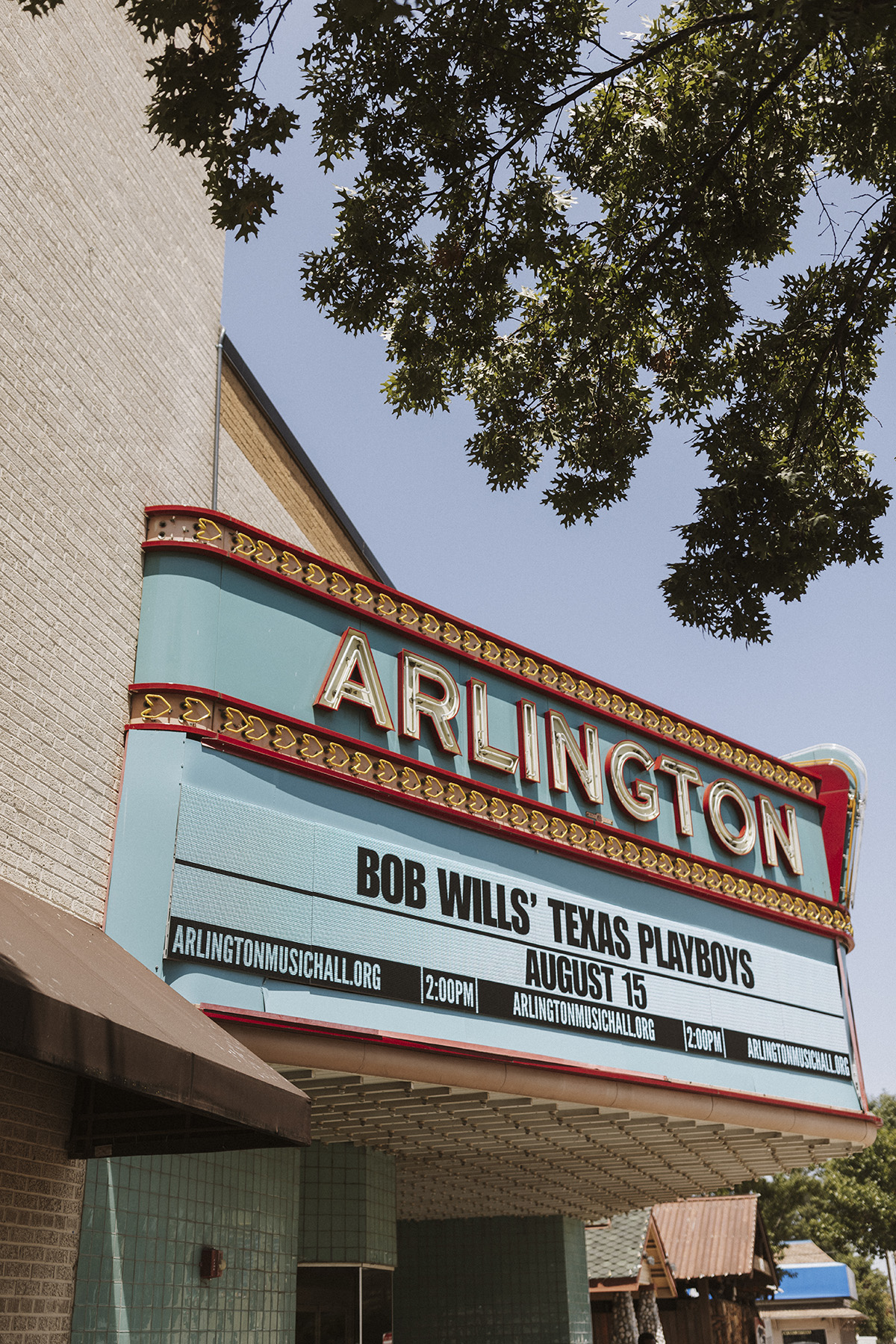
Health issues forced Wills off the road in the early 1960s, but he reunited with surviving members of the band for a recording session in 1973 before his death in 1975. Leon Rausch subsequently led the Texas Playboys until 2019, when he passed the lead singer role to Jason Roberts, the current leader of the band.
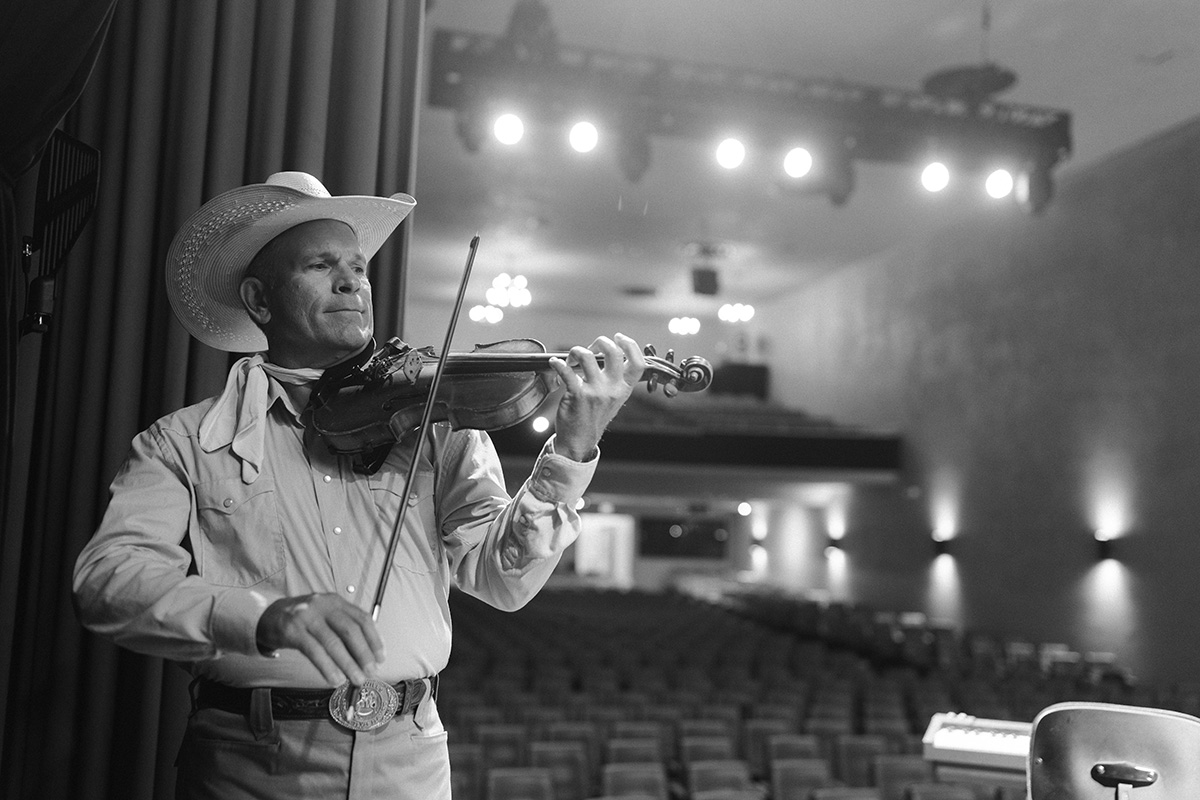
Roberts, a fiddle player who grew up in Lampasas, Texas, was raised on the sound.
“I grew up in Lampasas, Texas,” he explains. “My grandparents were all pretty good musicians. My grandmother played stride piano, and she was my earliest musical inspiration. My grandfather had a Western swing band in the ’40s where fiddler Johnny Gimble played with him. Johnny later played with Bob Wills. All those guys are my heroes.”
Roberts’ musical taste runs the gamut. “I go from Bob Wills to Beethoven to The Beatles,” he says with a laugh.
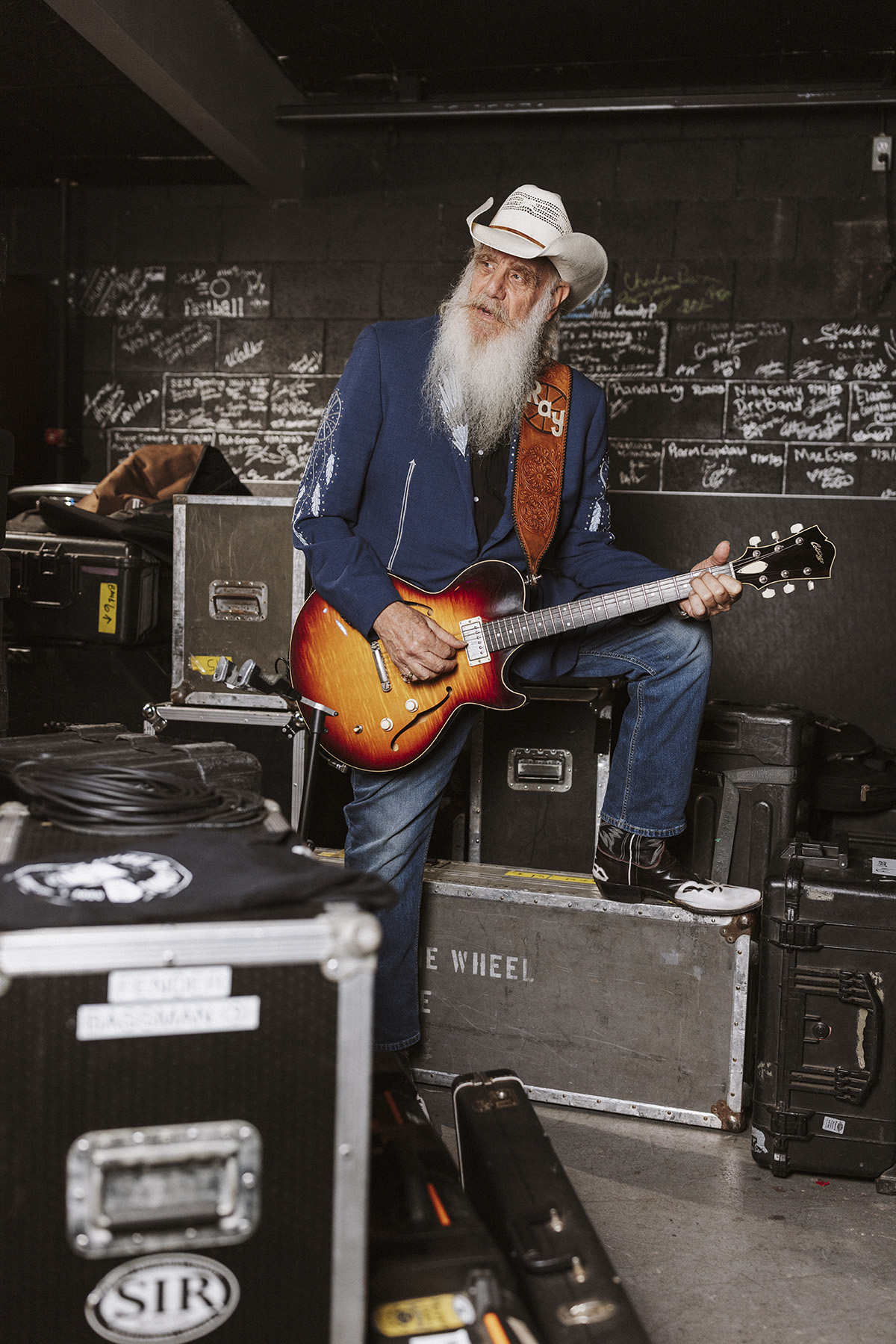
Over the decades, other musicians took the baton to carry the tradition forward, most notably Asleep at the Wheel and co-founder Ray Benson.
“They were all great musicians,” Benson says of his inspirations. “Elton Chamblin was a great guitar player, the great Bob Wills, Elvin Al Strickley, the great piano player, and Johnny Gimble was my musical father. These were all guys I met early on who helped us figure out how we fit into the music.”
Benson was a child performer who started singing folk music around age 9, and at age 10 he sang with the Philadelphia Orchestra. “We were always performing,” Benson says. “I just wanted to play music.”
Today, mainstage icons like George Strait remain connected to Western swing’s lineage, while a younger generation — including Fort Worth-born Drake Milligan — is bringing its own brand of honky-tonk and swing to new audiences.
It seems appropriate that so much of this momentum returns to Fort Worth. Nearly a century ago, the city served as a meeting place for musicians carrying different sounds with them. Rural Texas met urban jazz. Black blues met white fiddle traditions. Mexican musical influences mingled with Tin Pan Alley songs. Radio met the dance hall. Tradition met electricity.
The result did not sound entirely like any single one of them — it sounded like Texas.
And maybe that is why Western swing has such staying power. It was never a museum piece to begin with; it was music created by borrowing, experimenting, and moving forward. Nearly 100 years later, the fiddle strikes up, the steel guitar answers, and couples still move toward the floor. The swing, it seems, has come back around.
Join in The Cowtown Birthplace of Western Swing Festival for its sixth year at Historic National Hall from Nov. 12–15.
The first three days of this year’s festival will take place Nov. 12–14 at Historic National Hall and will culminate at Will Rogers Auditorium on Nov. 15 with Dave Alexander and his 65-piece orchestra.
For tickets and more information please visit birthplaceofwesternswing.com