


By Hannah Barricks
Photography by Crystal Wise
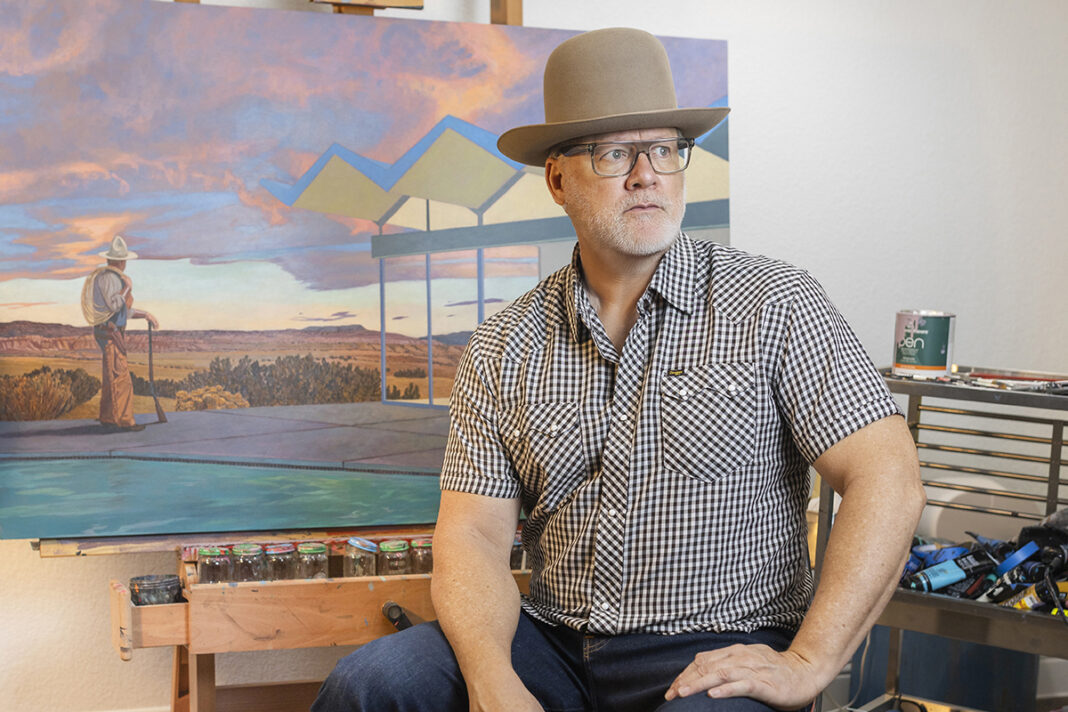
Artist Kevin Chupik paints the modern cowboy, not as a relic of the past, but as a traveler through time — drifting between desert highways, mid-century America and the ever-shifting border between tradition and reinvention.
That sensibility arrives quietly at the William Campbell Art Gallery this month with a single work: “Wishing Well,” scheduled for display on Jan. 15 through Feb. 7.
“I just have one piece that’s going there,” he says over the phone, unable to meet for an in-person interview a few days before Thanksgiving.
But the modest clarification belies the scale of the story behind the work — a story shaped by the American Southwest, a decades-long teaching career, a life-altering fall and a return to Texas that reshaped both his life and his art.
But Chupik doesn’t dive into that right away. His approach is slow.
A local boy with roots at the Fort Worth Stock Show and Rodeo — his grandmother worked in the front office, and his mother grew up playing underfoot — cowboys were part of his upbringing, and would become a central figure in his art.
Chupik wields the iconic character to convey themes of independence, self-destiny and solitude.
He earned his undergraduate degree in painting and drawing from Texas Christian University in 1992, then headed west for graduate school at the University of Colorado at Boulder. During those four years in Boulder, he traveled extensively through southeast Utah and the Four Corners region — backcountry terrain that permanently changed his visual language.
That landscape, he says, still inspires him and his work today.
In 1997, while working as a mountain bike guide near the Grand Canyon, Chupik fell 30 feet off a cliff at the North Rim. The accident left him with years of rehabilitation and dramatically shifted the trajectory of his life. The freedom that once defined his movement through the desert vanished overnight.
“After handling the physical, it was a couple of years just getting my head straight,” he says. “I had an active life and was building a career out there around it; having it all taken away was hard.”
The fall did not end his ambitions; however, it did cause them to evolve. Having always been a talented painter, Chupik traded his bike for a brush and began leading a Saturday art class at a college in Las Vegas, his first position after the accident.
Teaching stuck, becoming a 16-year career at the College of Southern Nevada, where he instructed students in the fundamentals of painting, drawing and design.
With art, the desert terrain that stole Chupik’s heart remains within reach.
“My work became a way of keeping something alive,” he says. “Love and wonder, specifically.”
In 2012, Chupik and his wife welcomed a daughter. Four years later, the family left Las Vegas, not wanting to raise a family there, and moved to the Texas Hill Country, settling near Aledo in 2022.
The return to Texas triggered a slow but unmistakable shift in Chupik’s work.
“I noticed a change when I finally warmed up to the idea of returning to Texas,” he says.
Before that, his work exhibited the same contemporary notes it’s known for today, just without the Western focus. That transition began in 2014 with a show titled “Clarity of Youth,” where he featured the trains and cowboys he had loved as a child. By 2018, his work had completely transformed. Cowboys dominated the canvas. A place where horses stampede across striped fields in graphic rhythm. Chupik often paints them on round wooden forms and cradled wood panels – another signature of his work.
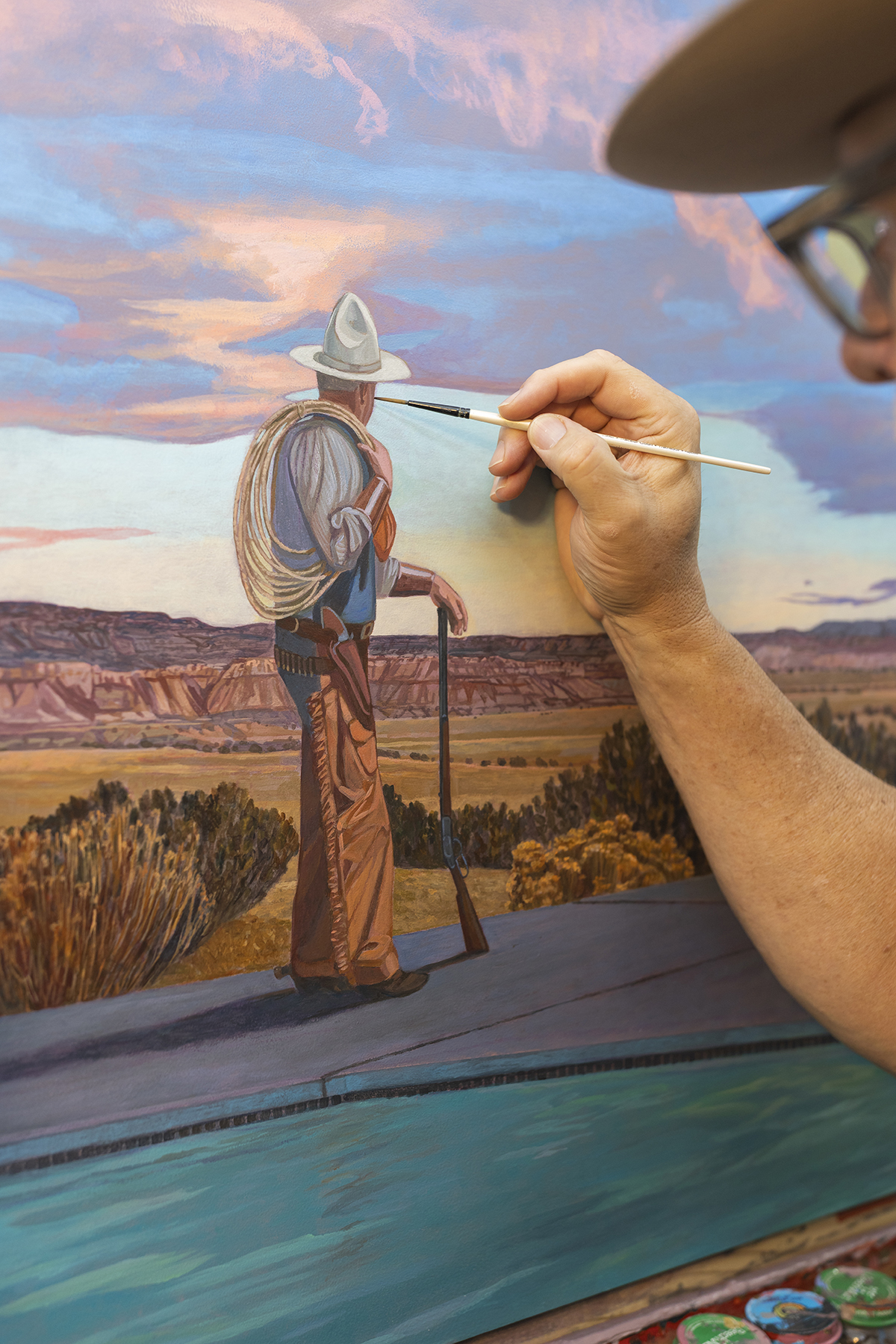
A constant in the aesthetic is a figure Chupik calls the “modernist cowboy” — a lone figure moving through mid-century America, drifting between small towns, deserts and cities, a captive of Chupik’s nostalgia, sharpened by contemporary edge.
His cowboy is a “liaison,” like Dante Alighieri’s Virgil, a guide through shifting worlds.
“He symbolizes independence and exploration,” Chupik says. “Ruggedness, and being in charge of your own destiny.”
The work intentionally lives between tensions: rural and urban, old and modern, traditional landscape and contemporary abstraction. But it refuses to settle fully into either camp.
“I want the push and pull,” he says. “The tug of a familiar setting combating against the allure of the unknown.”
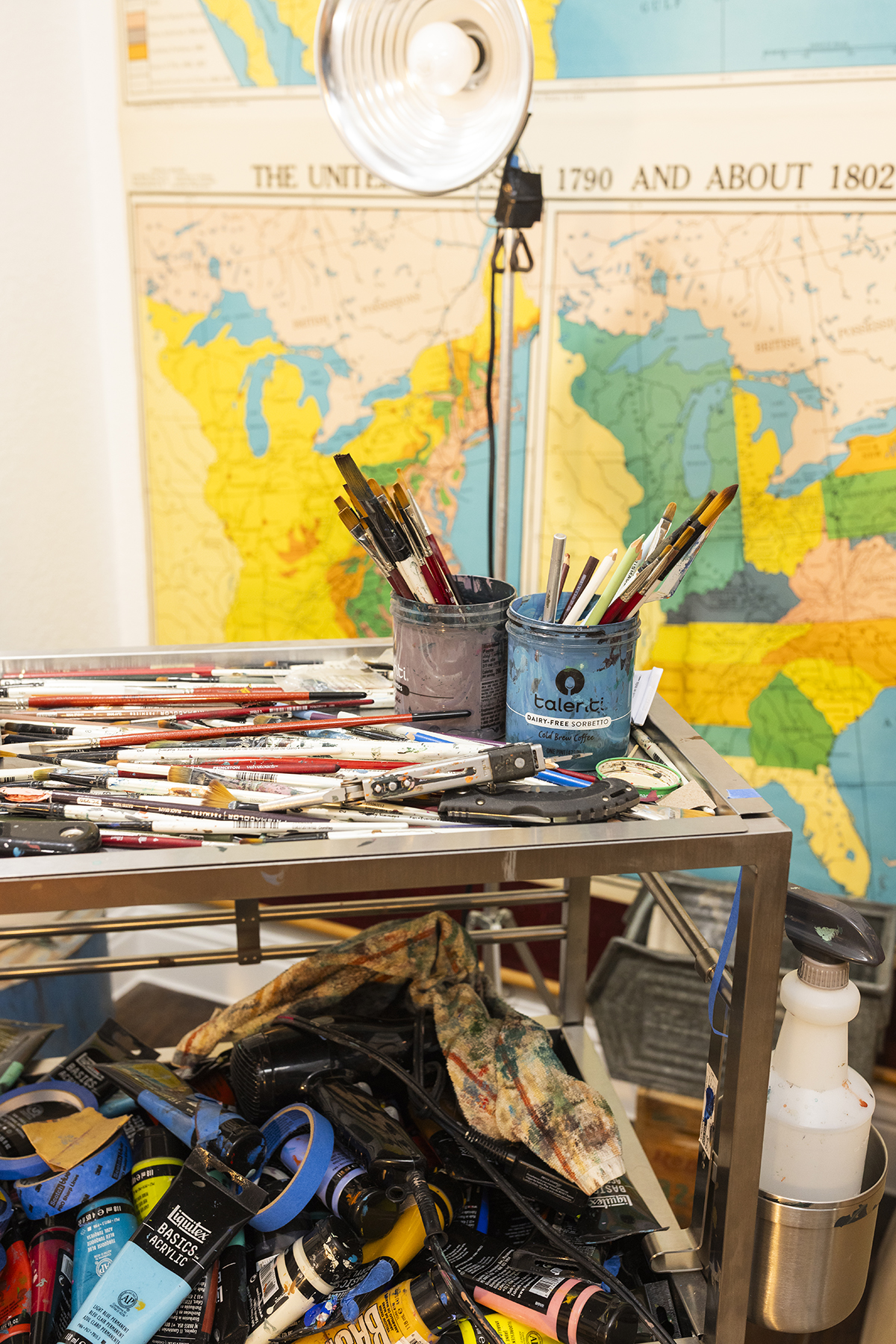
No longer tolerating the fumes from oil paints, Chupik moved exclusively to acrylics in the early 2000s.
He uses the digital app Procreate to collage historic photographs, drawing and layering them until he’s satisfied and the image is ready for a wooden panel.
“I use technology in a traditional sense,” he says.
The result feels archival but immediate — almost like déjà vu.
For years, Chupik relied on galleries to exhibit his work, but has since found more success on his own.
“My career takes off in conjunction with me leaving galleries,” he says. “I’m not concerned with playing a traditional gallery game. I mostly work for collectors directly.”
It’s a winning model that has Chupik booked solid with commissions for three years. His original works often pre-sell before they’re publicly released. He’s also built a thriving print business, making his work accessible to a broader range of collectors.
“Not everybody has $20,000 to plop down on a piece,” he says.
Social media, particularly Instagram, accelerated this shift. Between 2021 and early 2022, his work went viral on the app, increasing his following from 500 to nearly 50,000 people worldwide.
“That’s all grassroots,” he says. “Grown organically.”
The timing coincides with a resurgence in the international popularity of Western imagery — but he is careful to distinguish his work from any trend-chasing or worse, coattail-riding.
Chupik says he’s been contacted by producers connected to “Yellowstone,” but stops short of sharing any juicy details. Several of his pieces have already appeared in the television series “Landman,” also in Taylor Sheridan’s milieu.
As his visibility grows, Chupik remains uncompromising about authenticity. He believes genuine work reveals itself immediately — and so does deceit.
“I can pick out inauthentic work,” he says. “Shortcut work. Cheat work. Mimicry.”
His stance on artificial intelligence is absolute.
“I will never use AI to create imagery,” he says.
He believes its widespread use threatens the uniqueness that gives art meaning, calling it a hack that forces viewers to settle for a bastardized version of creation.
He also refrains from painting about his accident and vehemently denies the existence of any Easter eggs within his work.
Yet every landscape is one he once freely explored, a feeling, not just a moment, immortalized in paint and wood for Chupik to revisit whenever he wishes. Here, the great Southwest is eternal — filtered through his memory and imagination.
It’s also a way that Chupik can refuse erasure. For what is truly lost if it still matters to one man – kept alive in his mind to explore at will?
As “Wishing Well” quietly settles onto the walls at the William Campbell Art Gallery in mid-January, it does so without a dramatic unveiling. Free from any declaration of a new chapter and overt statements of renewal.
And yet, the timing fits.
Chupik now lives back in Texas, his work fully aligned with the real-life imagery that shaped it. A child of the rodeo, hardened by the scarcity of the dessert. He operates on his terms — directly to collectors, unmediated by traditional gatekeepers — using a maverick approach that continues to grow his audience and harden his convictions.
He’s a contemporary art cowboy, and he’s returned home.
When he looks back at the student he once was, a young artist at TCU who yearned for the great outdoors, he notes that his goal never changed, even if the road did.
“It’s made me the person I am,” he says. “It’s made me stronger, tougher, smarter and more world-wise.”
There is no single moment of rebirth in the Kevin Chupik story. No neat turning point when everything resets at once. His story unfolded over time — revealing itself in geography, in memory, in material, in restraint and in his ability to continue inspiring wonder, even if things have never been more uncertain.
Because in his world, the modern cowboy keeps moving forward.