


By Hannah Barricks
Photography by Thanin Viriyaki
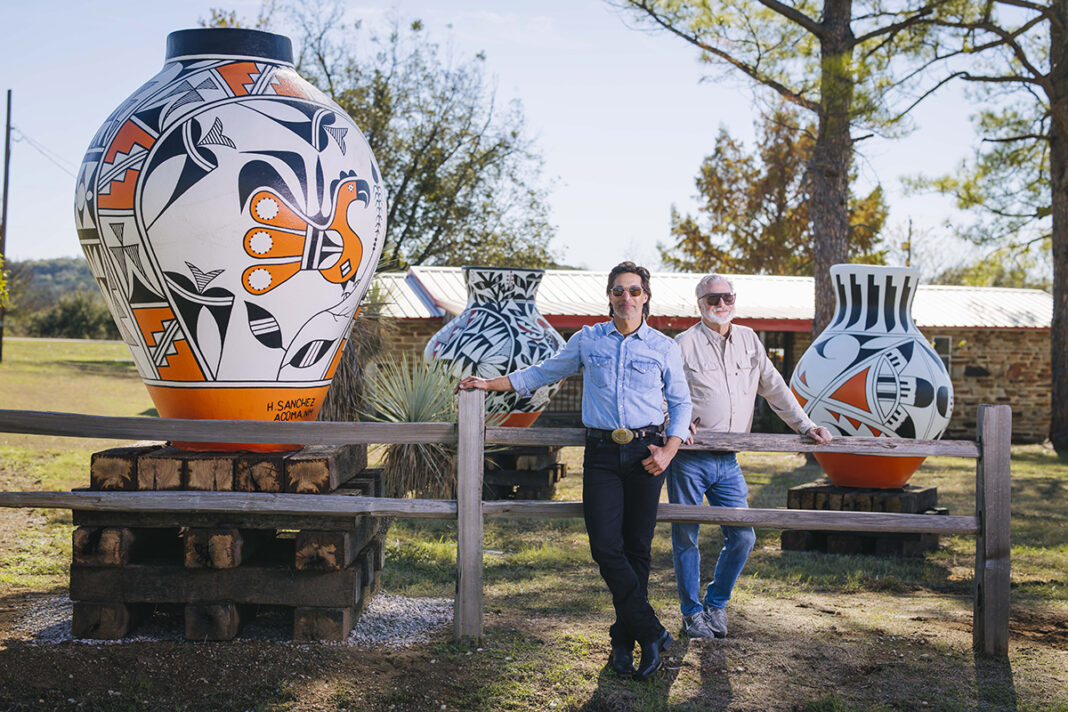
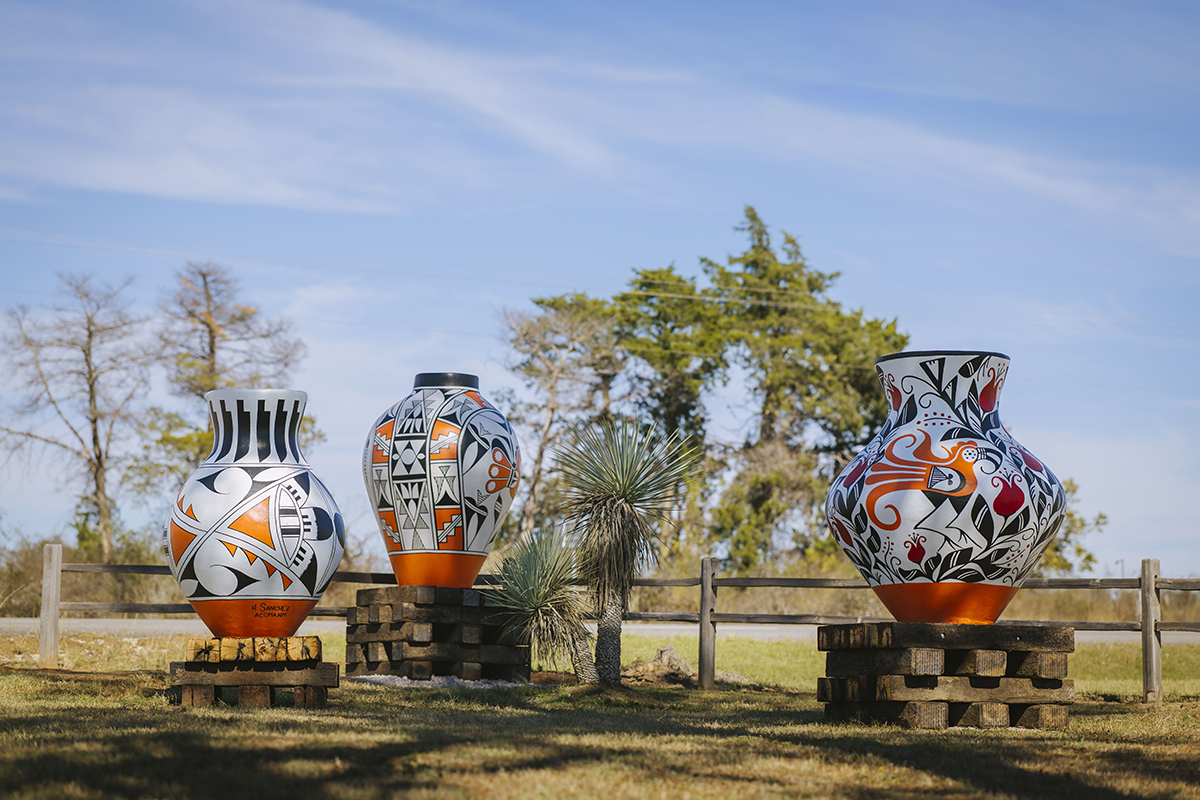
On a wide stretch of land outside Glen Rose, five massive pots sit facing US 67 from individual platforms, like ancient sentinels akin to Stonehenge or Easter Island’s iconic Moai monoliths. Reaching 8 feet tall and weighing almost a ton, the giant crocks are large-scale reproductions of Native American pottery, hand-painted with animals and symbols from nature that tell a visual story. Big Deal Farms, an antique mall in Somervell County, recently installed the pots on-site as part of an outdoor art gallery that required years of careful planning and logistical acumen to pull off. But most importantly, it took passion, the kind that’s contagious.
The installation began as the dream of Big Deal’s owner, Kirk Lancaster, who splits time between a sprawling ranch in the county near the mall and a townhouse in Fort Worth’s cultural district, which he affectionately calls the “Little Bowie” for its resemblance to the iconic hotel and gallery, Bowie House. Lancaster’s interest in Native American art began in adolescence and continues today, with impressive collections at both of his homes.
He first encountered large-scale pots nearly 20 years ago at the Albuquerque airport, where an impressive display, similar to the one he owns now, still greets travellers with colorful symbols of regional wildlife. The scene remains an unequivocal show-stopper by everyone who has seen it firsthand.
“It made a huge impression on me,” Lancaster says. “They tell a story that feels universally human. Something that connects us, maybe from our oldest memories.”
And earlier, at age 6, Lancaster traveled with his parents to Santa Fe and Taos Pueblo.
“I’ve been intrigued by Native American culture ever since,” he says. “Especially its art and the meaning behind it. I feel like every home ought to have a piece of Native American art or experience it at least once.”
The artist whose work caught Lancaster’s eye at the New Mexico airport is 83-year-old Benny Duran, a fabricator from New Mexico specializing in western imagery and enlarging traditional pottery forms using wire, rebar, plaster and concrete. Once the forms are sanded and primed, Duran calls in Native American artists from the area to hand-paint each vessel, layering them with centuries-old symbols used by the earliest Americans.
“Everything tells a story,” Lancaster says. “Mostly from nature.”
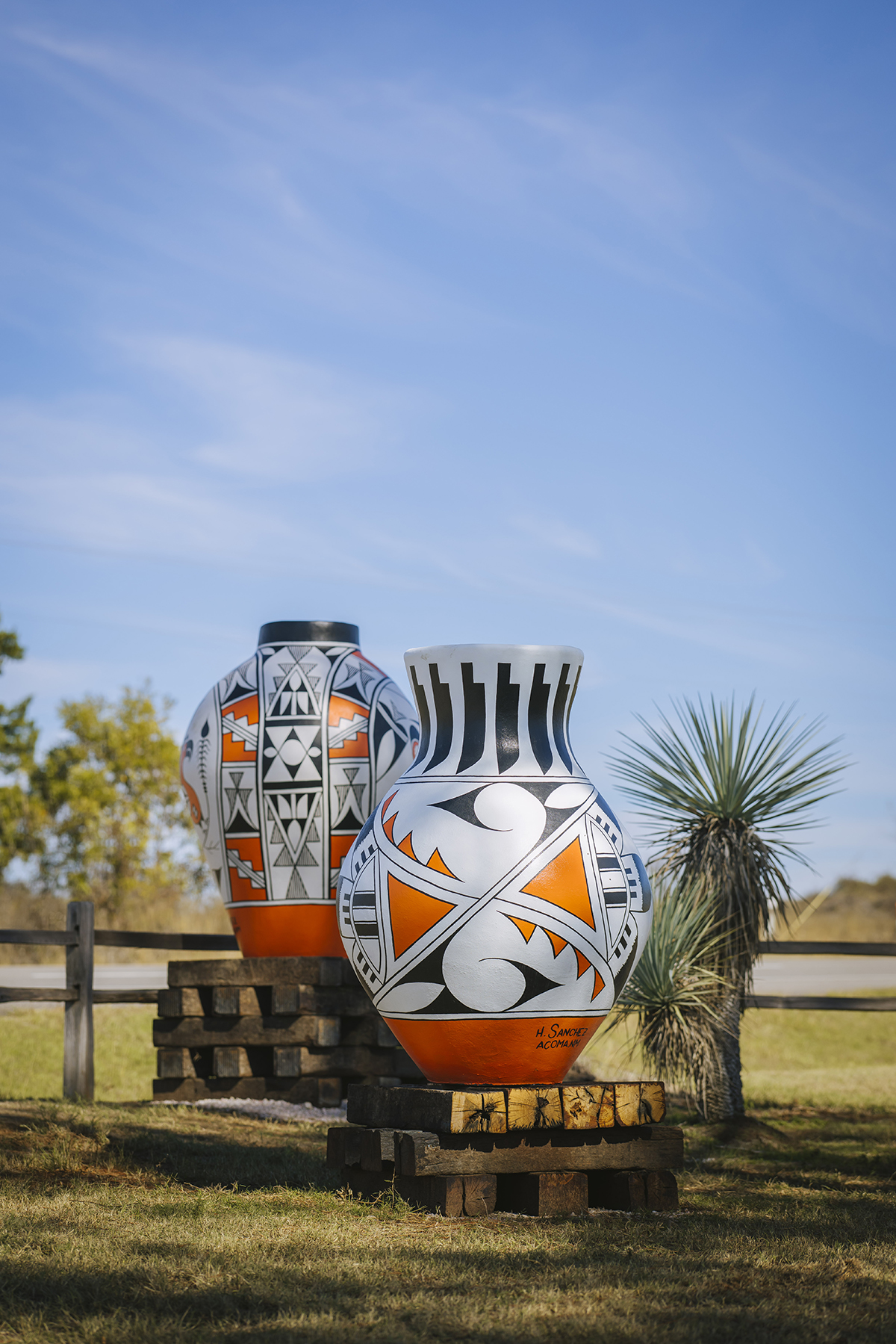
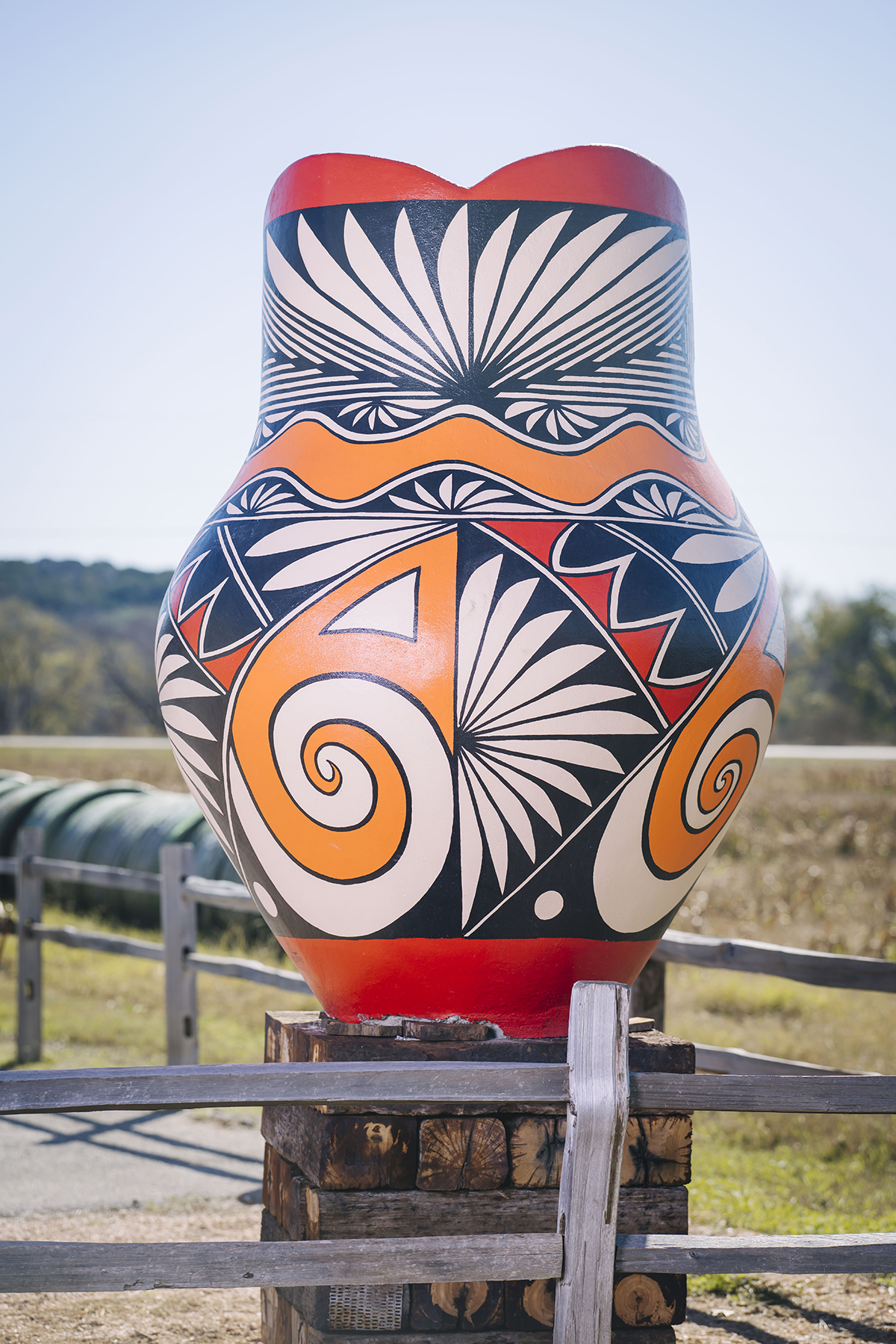
A closer examination of his own pots’ designs in Glen Rose validates the claim: hummingbirds symbolize endurance, eagles symbolize strength, and flowing lines symbolize water and continuity.
Historically, Lancaster explains that Native Americans disposed of broken or damaged pottery by smashing it to the ground in designated areas, or “returning” it to the earth. He removes a shard of cured red clay from his pocket as proof, the product of such “returns,” found amongst others by archaeologists in New Mexico.
Convincing Duran to make the giant pots was Lancaster’s next challenge after locating the artist at the start of the project. Already claiming retirement when Lancaster tracked him down near the airport in New Mexico about 15 months ago, the artist required persuading to return to the physically demanding work.
“He’s 83,” Lancaster says. “He keeps saying he’s retiring, but we’ve talked since then about him sending me more pieces.”
Duran’s perfectionism stems from a previous career in city government, where public safety demands precision during traffic-light and utility-pole installations. Those strict standards continue to shape his art, a labor of love that lures him back time and again.
“He says if he stops, it will age him,” Lancaster says. “That the work gives him purpose and keeps him going.”
With Duran secured, the next hurdle would be relocating the pots, once completed, 700 miles from the artist’s workshop in New Mexico to Somervell County, Texas. Enter Thomas Mullen, Lancaster’s longtime handyman and builder, to transport the pots and, eventually, design the supports they sit on at Big Deal Farms, structures he calls “plinths.”
At 1,600 to 2,000 pounds each, Mullen required the assistance of Duran’s 1963 boom truck and a three-person crew to load the pots onto a 26-foot flatbed ahead of their cross-state journey.
“Every time I stopped the truck, it would take at least 30 minutes,” Mullen says, “From strangers and cars that passed by the pots and wanted to take photos and ask me questions about them. People seemed almost compelled to experience and learn about them.”
Mullen designed and built the plinths from repurposed railroad ties, stacked like firewood and drilled into place. During construction, Mullen uncovered the original steel nails used by railway workers in the 1920s through 1940s, embedding another layer of American history in the exhibit– now open to all.
“It’s an opportunity for exposure to Native American art that people can actually interact with,” Mullen says. “You can walk right up to the exhibit and touch and feel it.”
That invitation — to touch, stand beside or simply admire — is central to the project. Traditional museum settings often place Native American art behind glass, but Lancaster rejects that distance.
“They make a statement,” Lancaster says. “It’s a loud statement of, ‘This is what Native American art is about. Can you see it?’ Or better yet, ‘can you feel it?’”
Each vessel costs thousands of dollars to fabricate, with Lancaster estimating their value anywhere from $20,000 to $30,000, higher if Duran ever stops producing them. But Lancaster promises that at least the two largest pots will remain outside the mall in Somervell County as permanent public anchors.
Inside Big Deal, more than 70 curated vendors and artists showcase fine antiques, Western art, industrial design, folk art and contemporary collectibles. Lancaster often walks the floor with an unlit cigar resting at the corner of his mouth — damp at one end — dispensing advice, stories and one-liners that beg to be resampled.
His Fort Worth home, the “Little Bowie,” is bold, layered and more modern than the ranch, with various contemporary art pieces hanging alongside his beloved antiques. He shares how his nephew, Luke, wants him to install one of the smaller pots at his city property. Although he had intended them only for public display and private sale, he is considering the idea, but remains undecided.
“I hope that they inspire people,” Lancaster says.
Mullen describes himself as profoundly changed by the experience, calling the work “mesmerizing.”
“You see all the different images and the way they flow together,” he says. “It’s like getting lost in a galaxy. It pulls you in.”
There are plans, too, for what might come next. Duran’s family, now led by his daughter, Donna, and grandson, Jonas, continues to fabricate large-scale metalwork alongside the pottery: creating full-sized stagecoach scenes with galloping horses, buffalo sculptures and towering insects, all built with extraordinary detail. Lancaster wants people to see those works as well, and reminds Mullen to discuss the possibility with him later.
For now, the pots stand quietly among the cedar and limestone, on bases made from railroad ties and Texas earth. Without signage or ceremony, the massive structures are unmissable.
“It brings us so much joy,” Mullen says. “That we can share this with everyone.”
In their stillness, the vessels seem at home, the final act from an ensemble cast and fulfillment of Lancaster’s long-held dream.
“They need to be shared,” he says. “Where everybody can have a piece of them.”
And now, just outside Glen Rose, he hopes people seize the opportunity he and Mullens made possible and become part of their story.