

By Rachael Lindley
Photography by Crystal Wise
It’s fitting that Catherine Cartie’s artistic journey began with a desire for perfection and ultimately became an exercise in letting go.
The Fort Worth artist, known for her vibrant watercolors and playful compositions, has built a creative identity around the very qualities she once hesitated to embrace: boldness, individuality and the confidence to take up space.
In many ways, her evolution as an artist reflects the spirit of the city she calls home — a place where tradition and innovation intersect and where generations of remarkable women continue to shape the cultural landscape.
Originally from Midland, Cartie came to Fort Worth by way of SMU and eventually TCU. She quickly fell in love with a city she felt was too often overshadowed by Dallas. She loved it so much, in fact, that she persuaded her parents to relocate while she was still in college.
Yet an artistic career was hardly part of her original plan.
Although creativity had always come naturally, Cartie never considered it a practical profession. She studied marketing and eventually accepted a position at Lockheed Martin, far removed from the colorful world she would later create.
“I would have loved it if I felt permission from myself to pursue that,” she recalls of her early artistic inclinations. At the time, creativity seemed more like a hobby than a viable career.
It wasn’t until she became a mother that Cartie began exploring calligraphy and, eventually, watercolor. Calligraphy appealed to her natural inclination toward precision, with rules to follow and forms to master. Watercolor, however, demanded something entirely different.
Pigment moves with water, colors bleed into one another and mistakes cannot simply be painted over. The artist must learn when to intervene and when to surrender control.
“A lot of watercolor is really soft. I like more bold and more layers and more contrast,” Cartie explains. “With watercolor, you can’t really control all of it.”
What began as an artistic experiment became a form of personal liberation.
“I used to not be as bold or colorful of a person as I am now,” she says. “I think watercolor and just creativity have had a lot to do with that, and it’s helped me come out of my shell personally.”
Once reluctant to attract attention, Cartie began embracing color, contrast and unexpected combinations in both her artwork and personal style. Today, one of the greatest compliments she can receive is when someone recognizes her work without seeing her name attached. For an artist who once worried about being too much, she has found the confidence to stand out.
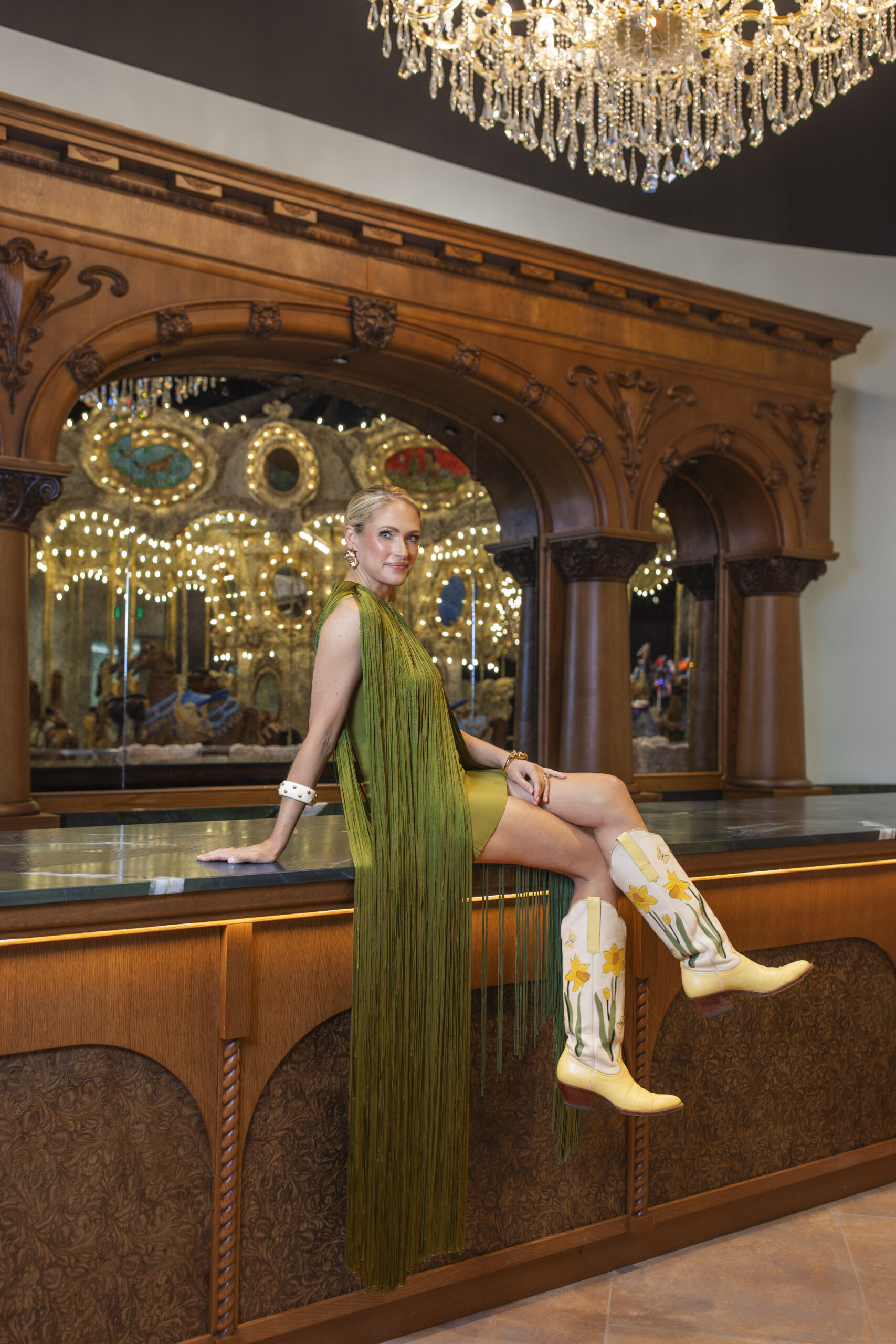

That transformation is especially evident in one of her most meaningful commissions: her contribution to the carousel at the National Cowgirl Museum and Hall of Fame.
The opportunity came through a network of women who recognized something distinctive in her artistic perspective. Following a recommendation from Lorene Agather, executive director of the Cowgirl Museum, Pat Riley approached Cartie about contributing to the museum’s carousel project.
Cartie remembers opening the unexpected email and being nearly speechless.
“My jaw was on the floor,” she recalls.
Her earlier Western-inspired watercolor series had caught the attention of those involved with the museum. Its blend of traditional subject matter and contemporary femininity offered just the sensibility they envisioned.
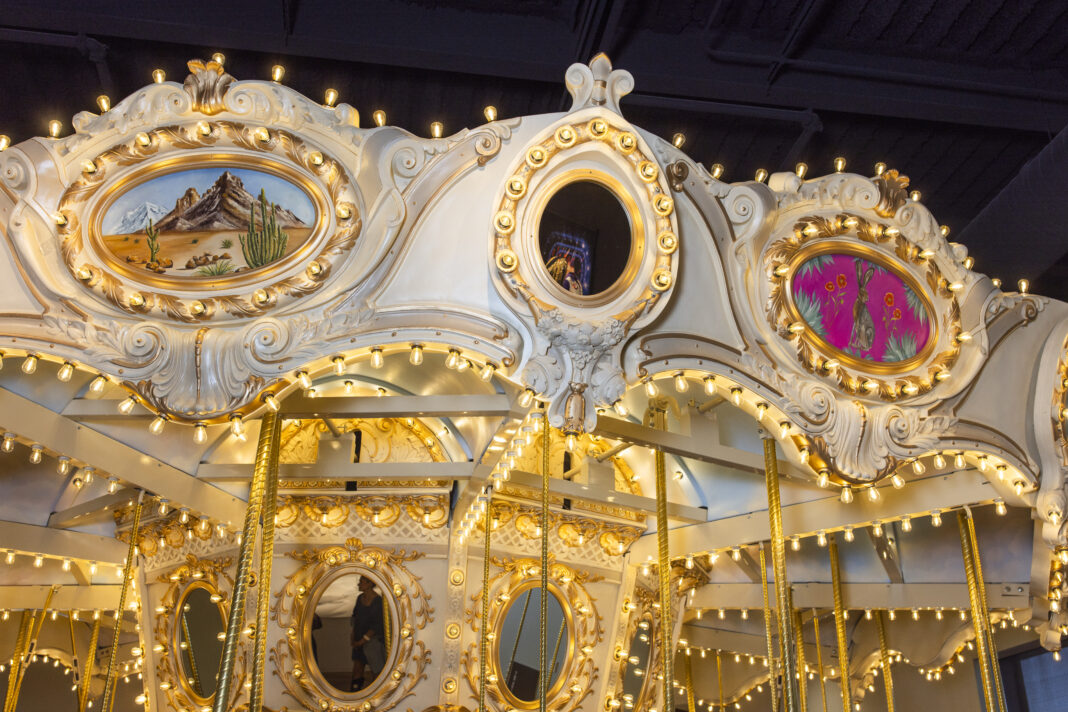
Given broad creative freedom and a request for a mix of animals and landscapes, Cartie designed the carousel’s rounding boards, the decorative panels that encircle the attraction. Although the project called for 10 designs, she estimates she created approximately 18 before the final selections were made.
She sent her artwork to San Francisco, where artisans translated the original designs to the carousel’s much larger scale. Seeing the first photograph of a completed landscape panel was a revelation.
“I couldn’t believe what it looked like,” she recalls. “It was so beautiful.”
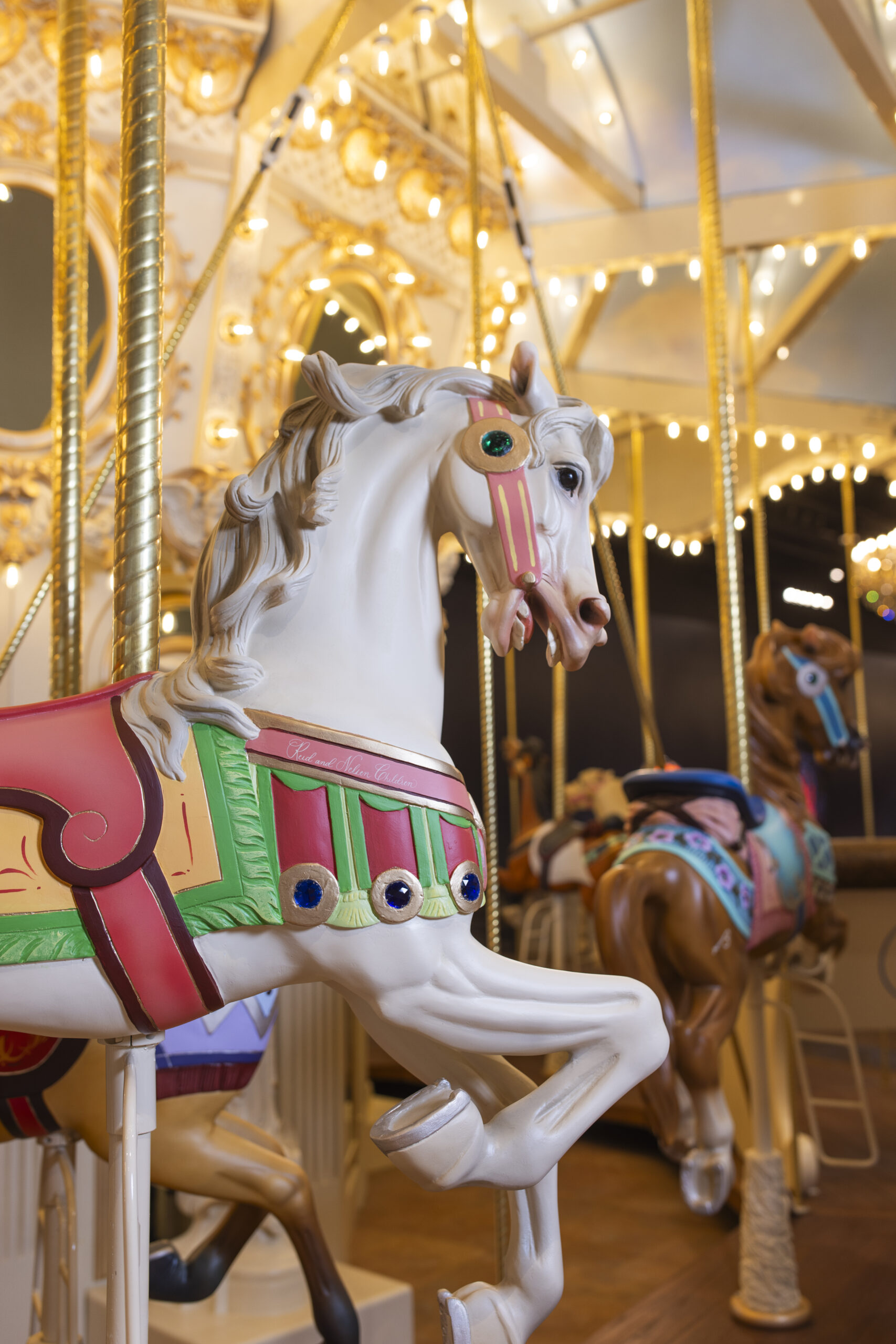
Cartie also designed a carousel horse for the Reed family, incorporating a cheerful palette of corals, greens and teals inspired by the family’s love of Seaside, Florida. She even included a butterfly, a personal and recurring signature in her work.
For Cartie, the finished carousel represents more than an artistic achievement. It connects her to an institution whose mission resonates deeply with her own experience of finding her voice.
The Cowgirl Museum celebrates women who have forged their own paths, challenged expectations and expanded the meaning of what it means to be a cowgirl. It is a definition Cartie sees reflected not only in the women honored within its walls, but also in those shaping Fort Worth today.
“Fort Worth is run by women, and in such a cool way,” she says.
For Cartie, the city’s female leadership is defined as much by generosity as influence. In Fort Worth’s creative community, she has found a culture of collaboration rather than competition.
“There are so many people who could be my competition,” she explains. Yet rather than guard their connections or opportunities, women are eager to help one another grow. They make introductions, share information and encourage one another’s success.
That generosity is woven throughout Cartie’s own story. Without the women who recognized her talent, recommended her work and opened doors, her path might have unfolded very differently. As her career has grown, so has her appreciation for the importance of extending that same support to others.
It is a distinctly Fort Worth kind of influence: personal, collaborative and grounded in the belief that one woman’s success need not come at another’s expense.
For Cartie, the museum’s expansion represents an opportunity to make that legacy even more visible to the next generation.
As the mother of two boys and a daughter, she sees the institution through a deeply personal lens. Her youngest, a spirited and fiercely independent little girl, already embodies many of the qualities Cartie admires in the women celebrated there.
“She is like a cowgirl without the horse,” Cartie laughs.
Her daughter has attended the museum’s Cowpoke Camp, where she has encountered stories of women whose courage and independence helped define the American West. Cartie hopes those experiences will encourage her daughter to embrace her individuality.
“I want you to grow up and lead,” she says of the lessons she’s teaching her daughter.
Equally important is what the museum teaches her sons.
“I love that my boys see powerful women,” Cartie says. They see women making decisions, leading institutions and shaping their community. To them, female leadership is not an exception to the rule. It is simply part of the world they know.
Cartie understands the significance of that perspective, having once struggled to imagine a professional future in art.
To her, being a cowgirl is about far more than horseback riding, ranching or Western heritage. It is about having the courage to forge your own path, the determination to protect what matters and the freedom to live authentically.
Those are the qualities she hopes to instill in her children — and the ones she continues to cultivate in herself.
In a city shaped by generations of formidable women, Cartie’s art has found a home in an institution devoted to telling their stories. There is something especially poignant about an artist who once hesitated to draw attention to herself, creating something meant to be seen, celebrated and enjoyed by generations of families.
Like the cowgirls who came before her, Cartie has discovered the power of trusting her instincts — and the even greater power of helping other women do the same.