


By Hannah Barricks
Photos courtesy of Tarrant County
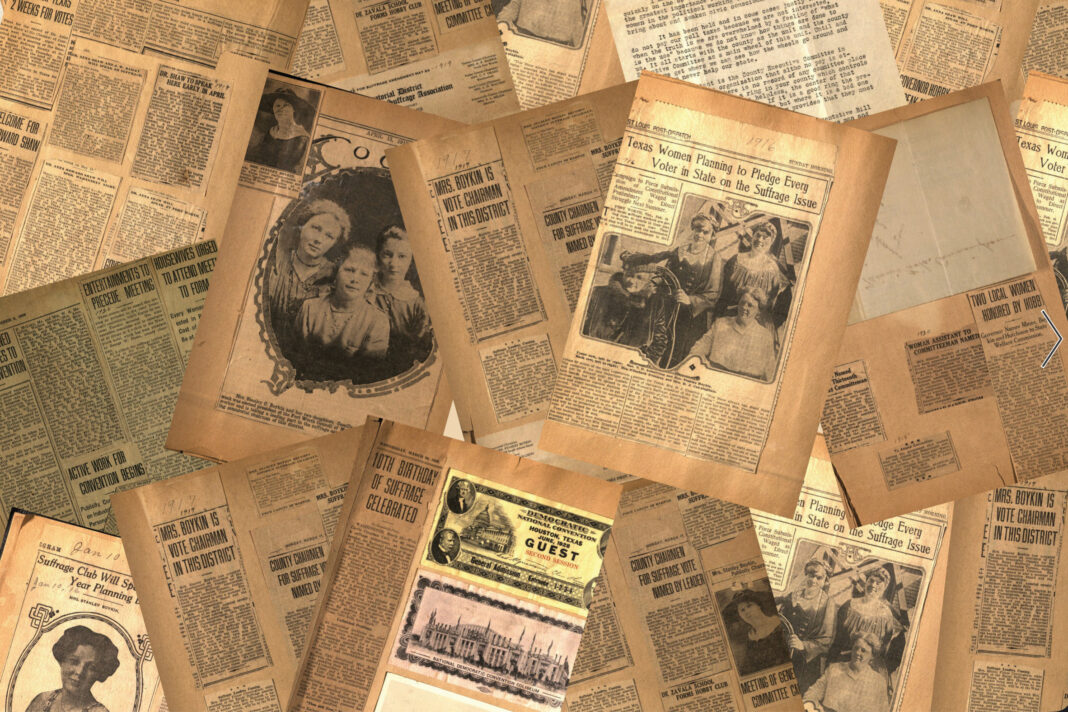
A newspaper clipping from 1915, preserved in a scrapbook compiled by Clota Terrell Boykin, now housed at the Tarrant County Archives, introduces her as the head of Fort Worth’s suffrage movement, describing a “statuesque blonde” whose “best asset” is a husband sympathetic to the cause.
The line stings — a small part of a larger feature that reads as both profile and positioning, an attempt to make Boykin’s leadership, and women’s suffrage as a whole, legible within the expectations of pre-Prohibition Fort Worth.
But by the time that article hit newsies on Seventh, Boykin was already at the center of a movement taking shape not only locally, but statewide. On Jan. 8, 1915, the Women’s Suffrage Club of Fort Worth formally organized, electing Boykin its first president and becoming one of the last major city chapters to form in Texas.
Organizers divided Fort Worth into districts, appointed ward leaders and held regular meetings in churches, theaters and public halls. They hosted speakers, distributed literature and spoke directly with neighbors — building support one conversation at a time in a city still defining what women’s political participation might look like.
Boykin, as president of the Fort Worth chapter, operated at the center of that effort. She worked in step with state and national organizers while leading local efforts to educate Fort Worth citizens and build support for suffrage.
Around her was a network of women whose names appeared less frequently in headlines but were no less essential to the work. The club organized down to the ward level, with officers and volunteers managing the day-to-day labor — arranging programs, welcoming visiting speakers and sustaining a steady cycle of meetings over several years.
Iconic activist and librarian, Jennie Scott Scheuber, joined the local chapter between 1918 and 1920.
Across Texas, leaders like Minnie Fisher Cunningham were transforming the Texas Equal Suffrage Association into a disciplined political force, aligning local chapters into a coordinated campaign. Figures such as Annette Finnigan and Jane Y. McCallum helped expand that reach, building momentum across the state through organized advocacy and political strategy.
National leaders also passed through Texas, bringing the broader movement with them. Anna Howard Shaw, president of the National American Woman Suffrage Association, was among those who spoke in Texas cities, reinforcing the connection between local organizing and a national campaign moving steadily toward constitutional change.
The scrapbook Boykin compiled captures that momentum in real time. It includes records of Shaw’s visit to Austin, along with legislative efforts and campaigns unfolding across the country. The materials reflect a careful rhetorical strategy: suffrage was framed not as a break from tradition, but as an extension of women’s civic responsibility — a message designed to resonate in Southern communities where resistance was anticipated.
Still, public support was uneven. Publications often described suffragists with skepticism or subtle dismissal. Women advocating for political rights were expected to lead without appearing disruptive, and to persuade without overstepping.
The pages of Boykin’s scrapbook move through meeting notices, programs and correspondence —small pieces of a larger pattern. Read together, they show how the movement advanced: steadily, consistently, without relying on a single turning point.
By 1918, those efforts began to produce measurable change.
Texas granted women the right to vote in primary elections, making it one of the first Southern states to do so. In Fort Worth, the shift was visible almost immediately. Registration efforts expanded, and the same women who had spent years organizing began guiding new voters through a process that had previously excluded them.
Meetings that once focused on persuasion turned toward participation — how to register, how to vote, how to engage in a system that had only just opened to them.
Women who had built the framework of the movement were now stepping into the system itself — not as observers, but as participants.
The effort did not stop at the state level.
Fort Worth organizers remained engaged in the national campaign to ratify the Nineteenth Amendment to the United States Constitution, continuing their work through advocacy, correspondence and public engagement as the amendment moved toward approval in 1920.
When ratification came, it marked a defining shift, but not a conclusion.
The same networks that had been built to secure the vote adapted to a new purpose: using it. In 1920, the League of Women Voters of Tarrant County took shape locally, reflecting a broader national effort to educate voters and encourage engagement.
Boykin remained part of that next chapter, becoming one of the first women from Tarrant County elected as a delegate to the Texas Democratic Convention.
More than a century later, the framework of female leadership that she built with her peers in Fort Worth still stands strong.
Not one “statuesque blonde,” but many — and together, they’re sure to make headlines in any decade.