



By Rachael Lindley
Photos courtesy of HY.Q
Richard Mochulsky’s path into entrepreneurship didn’t begin with a grand business plan. It began with a childhood based around activity and movement. From an early age, Mochulsky spent his time at hockey rinks, neighborhood bike jumps and watching his parents and brother compete in Southlake. Looking back, he sees how those early experiences quietly laid the groundwork for everything that followed.
“There was this level of activity that’s been a part of my life for as long as I can remember,” Mochulsky said. “We were always moving and doing stuff — sports, street hockey, bike jumps — it was just normal to us.”
Hockey became his anchor through adolescence, giving him confidence during years when he admits he wasn’t naturally outgoing. By high school, though, something shifted. He began to recognize that success didn’t necessarily belong to the most academically gifted students.
“I realized you could start something on your own,” he said. “You don’t have to be the most book-smart person in the room to succeed. You could just work really hard and be creative.”
That realization stayed with him when he enrolled at the University of Arkansas, drawn partly by its growing business program. College became his first laboratory for entrepreneurship. As a sophomore, he attempted to launch a laundry service aimed at fraternity and sorority members — a business he pushed nearly to launch before a key partnership collapsed.
The venture failed, but the experience clarified his direction. “Even though it failed, I thought it was a win,” he said. “I really enjoyed building and thinking of these ideas. I wanted to put something out into the world.”
That mindset led him to an unexpected opportunity with Red Bull as a student brand manager. The role proved transformative, giving him autonomy, responsibility, and a crash course in real-world business operations.
A competitive graduate program with the company took him to California, where he deepened his skills in analytics, category management, and beverage strategy. Over time, he deliberately moved toward smaller, faster-growing companies — including Health-Ade Kombucha and later Liquid Death — to broaden his exposure across the industry.
His career trajectory was intentional, and after his first failed business attempt in college, he decided to learn from established brands before trying again. “I wanted as much experience as I could possibly garner,” he recalled thinking. “I wanted to learn from the best and hopefully be more valuable when I finally established my own thing.”
The idea that eventually became HY.Q emerged at the intersection of professional insight and personal history. Years of industry data analysis showed him how Gatorade remained dominant in sports drinks — holding roughly two-thirds of the market — while consumer preferences were shifting toward cleaner ingredients.
At the same time, his own active upbringing made the opportunity feel personal.
“I couldn’t name a modern version of a sports drink that fits how people live now,” he said. “That’s when I realized there could be something here — there was a gap in the market.”
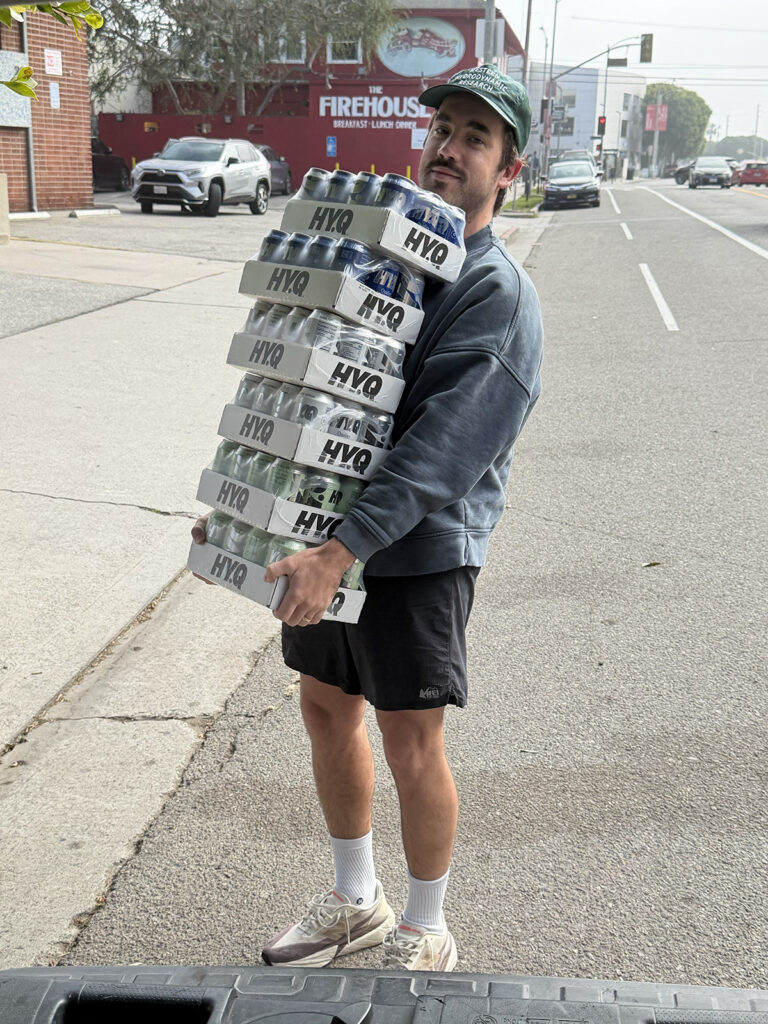
HY.Q was designed around three principles: familiar taste, intentional electrolyte balance, and simplified ingredients. Rather than chasing trendy functional additives, he focused on hydration that mirrored what the body actually loses through sweat.
“The goal has always been to create something that’s very palatable,” he said. “You should be able to get in two sips and not have any qualms about how it tastes.”
Launching a beverage company from scratch has been as challenging as he expected — capital-intensive, operationally complex, and dependent on retail partnerships. Still, momentum is building. His ambitions include expanding into Texas retailers such as H-E-B, Tom Thumb, convenience stores like 7Eleven, and eventually national players like Walmart — milestones that would feel deeply personal given his upbringing and college experience.
“There are a few accounts where if we get into them, it will feel like a full-circle moment,” he said.
Entrepreneurship has also coincided with major life changes. His daughter was born the same day as one of the company’s first production runs — a symbolic overlap of family and business that captures this season of his life.
Today, Mulchulsky views HY.Q not simply as a product but as a reflection of his philosophy: support everyday effort, not just elite athleticism.
“I don’t want to compete with the big brands by signing huge athletes,” he said. “Let’s support activities people actually do… do something that makes you sweat.”
For him, entrepreneurship isn’t about disruption for its own sake. It’s about building something useful, authentic, and lasting — one carefully executed step at a time.