

By Hannah Barricks
Photography by Crystal Wise
While driving to Red Steagall’s ranch in Parker County, one’s mind can wander. The land opens, one lazy turn at a time, flowing from the horizon in rolling bolts of pink and green as the sun begins to set. The downy-tipped stamen of native purple grasses all bend conspicuously to one side, frozen in place after prolonged seasonal winds forced their submission. To my roaming mind, though, they resemble arrows, and I follow them.
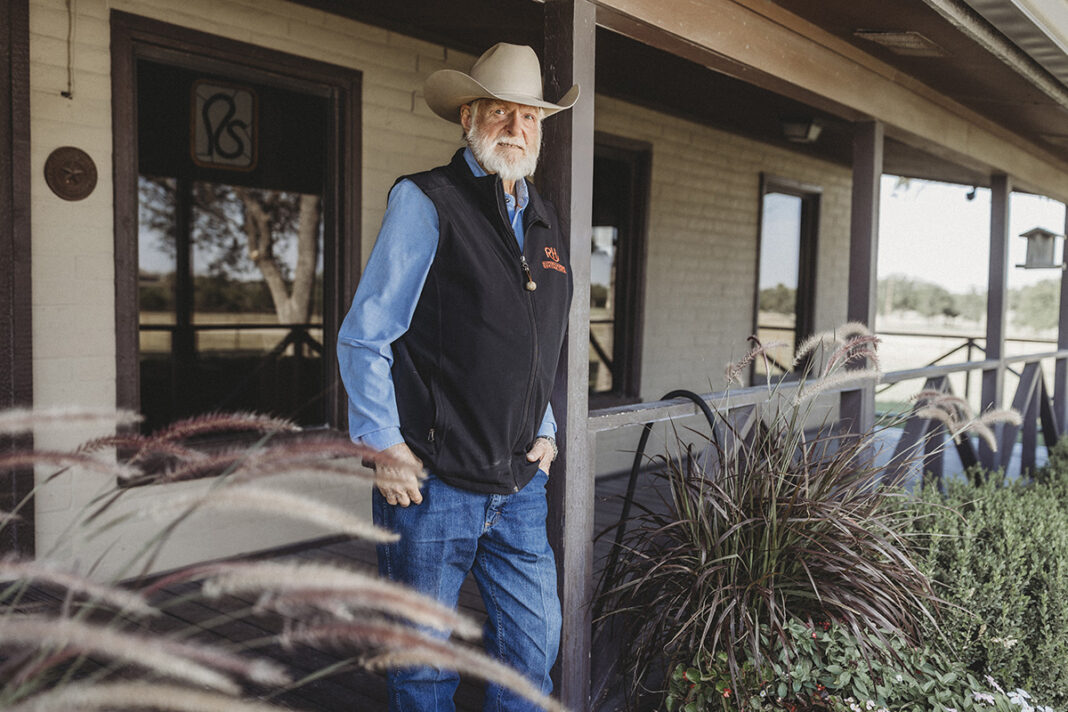
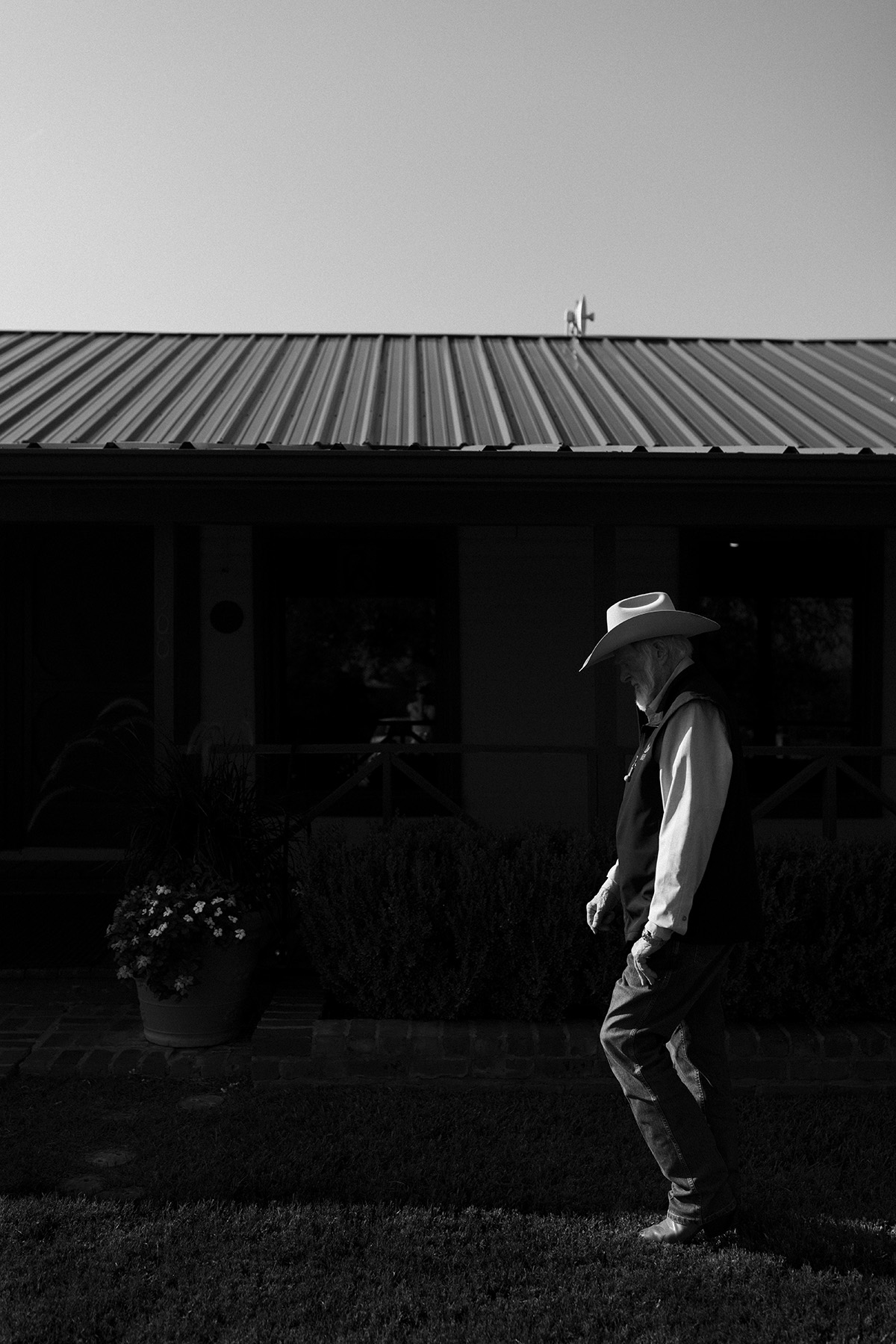
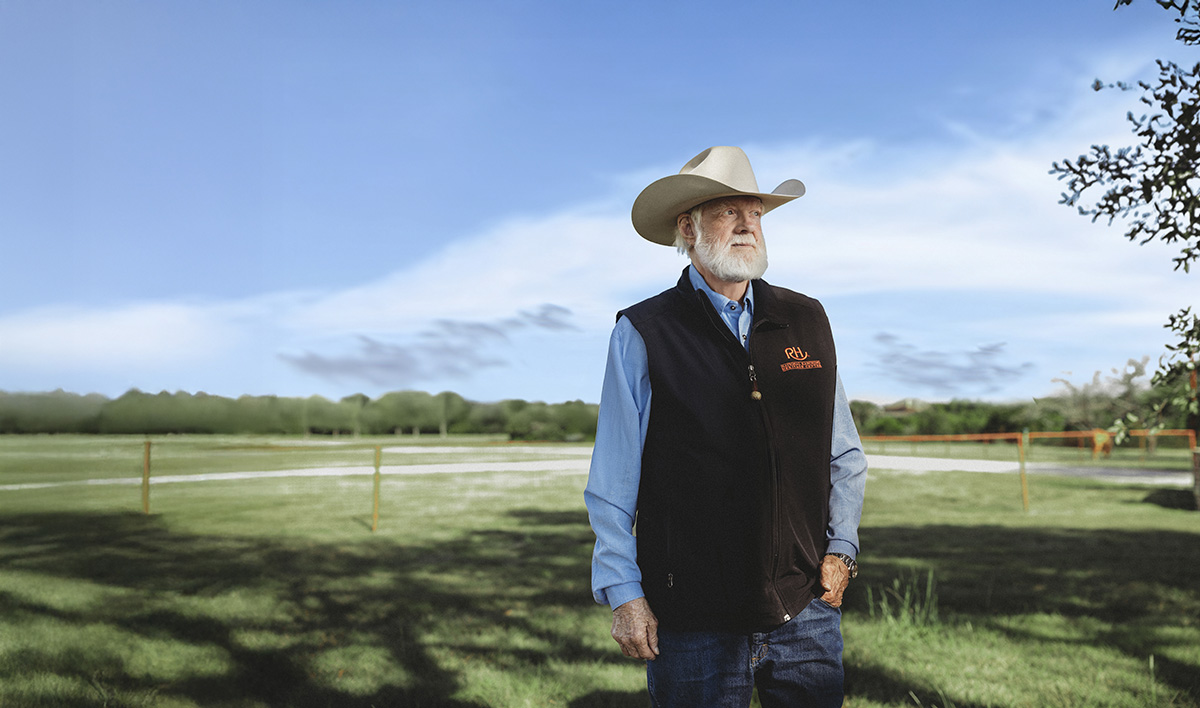
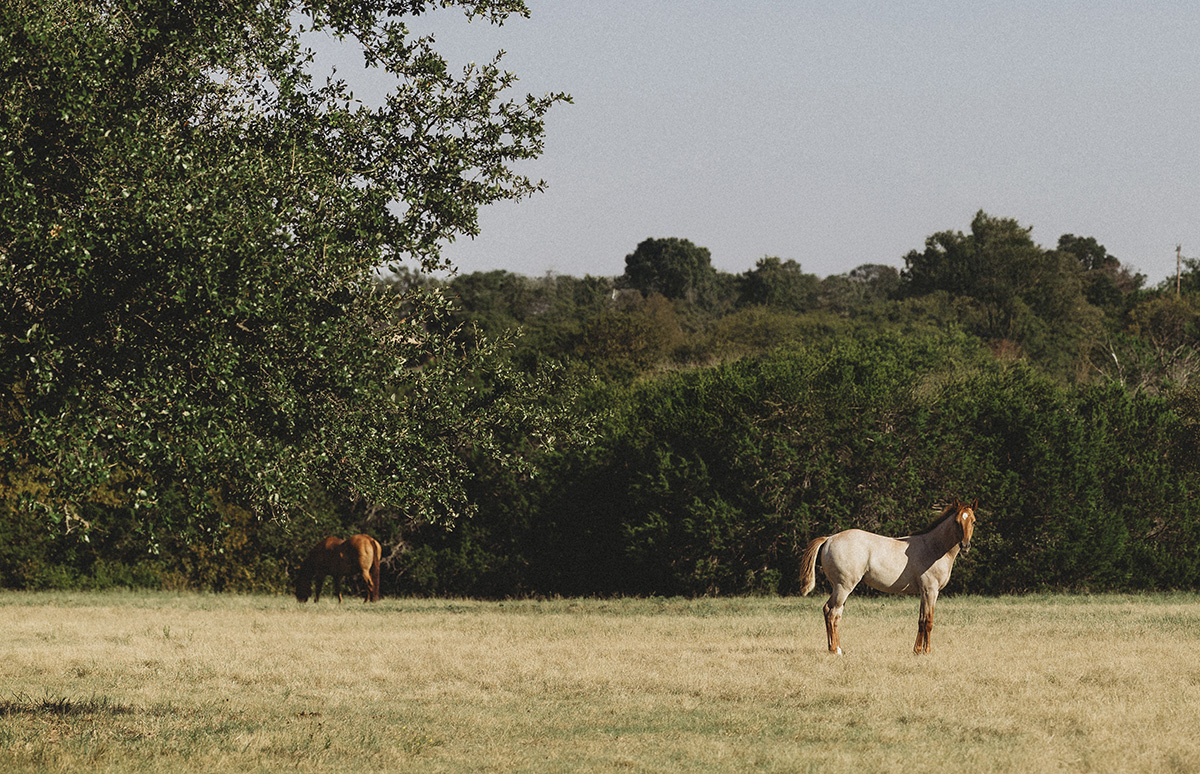
Reaching the dead end of a dirt road, I find Red, still hard at work on his ranch, surrounded by his remaining cutting horses and ponies as they graze between the property’s live oaks and make use of the tree’s meager shade. He says there are longhorn steers out there, too, but none are visible from his office window at the front of the property. If Red says they’re out there, though, they are. There’s a trustworthy rhythm here with him at its center. An unmistakable authenticity that radiates from anyone living close to the land, and Red Steagall, the Official Cowboy Poet of Texas, National Golden Spur Award winner and Great Westerner, has nearly five decades of it under his belt.
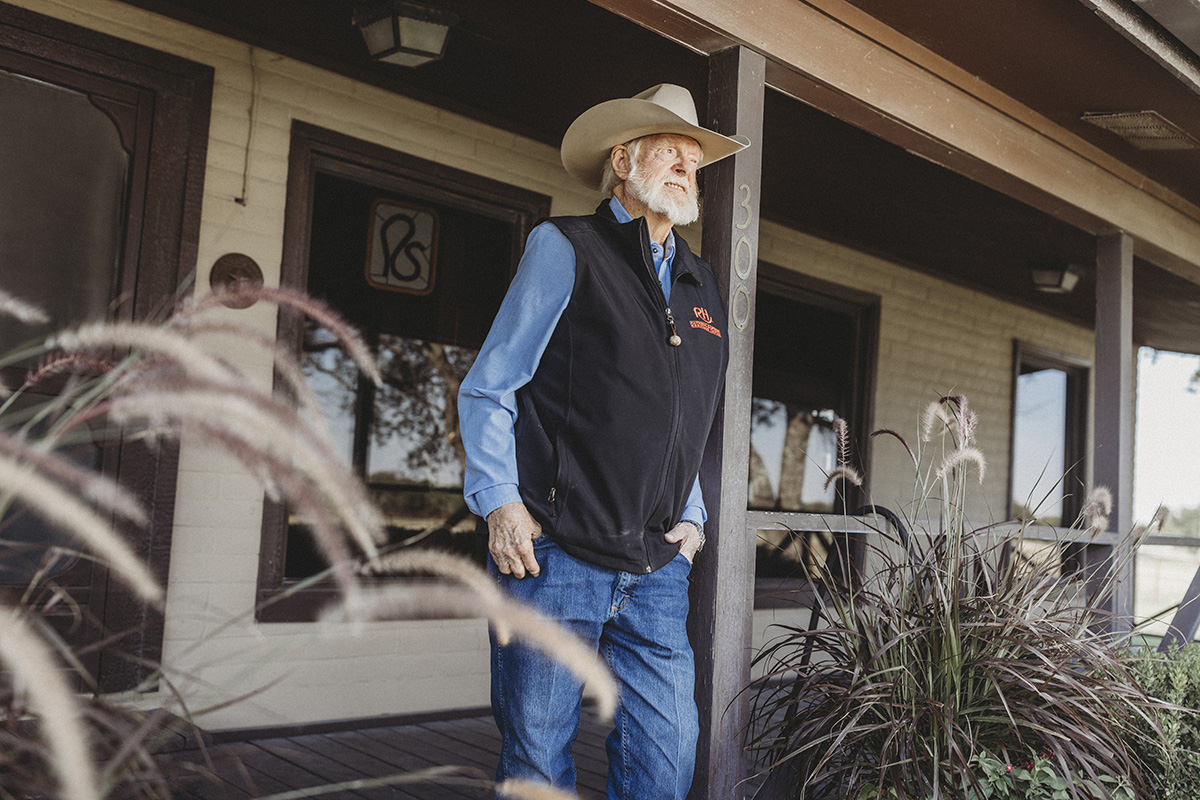
Red tells me he’s lived here with his wife, Gail, for 48 years. We’re sitting in his office, a sturdy building once meant to house his tour bus and band. The vested, giant of a man in both size and reputation, lounges only feet away, comfortably, in a black office chair, with one perfectly-pressed, denim leg draped over the other. The white-haired man is warm and dreamy, yet firm and unmistakable with his words.
“I love to be at home,” he says. “I built this place because I didn’t want to spend every day in an office. I’d rather work where I live.”
Inside, the wood-paneled walls are heavy with memorabilia spanning Red’s career in music, poetry and broadcasting. Each note and photograph is a rarely-seen cultural artifact from the early days of country music that demands viewer appreciation.
Still, we remain seated, allowing the final rays of daylight to fill the room and warm us. Red’s achievements surround him like a chief sitting among his spoils of war, but he speaks instead of his values, listing honesty, respect and hard work as the foundation of what he calls the “Western way of life.” He mostly credits his education in these ways to his mother, Ruth. The former schoolteacher imparted all that she knew of the West to her six children before leaving this world — gone for some time now, Red says, no doubt serving her Maker as faithfully in death as in life.
Her lessons had a profound impact on Red and are eternalized in his art, honoring his family’s way of life like a fireside storyteller weaves a dusty yarn from behind the brim of his hat. So, listen closely, everyone. Follow the Gulf muhly down the dirt road until it dead ends. The old cowboy has another story to tell, and this time, it’s his.
As a boy living in the small town of Sanford, Texas, Red’s first standoff was against polio. Despite emerging victorious, the illness weakened his left arm and shoulder.
“I played the mandolin to bring back the strength in my fingers,” he says. “Eventually, I had enough dexterity to play open chords on the guitar.”
The experience would be a wormhole into the music business.
Before then, Red had wanted to become a veterinarian, but the long-term effects of his illness made the physically demanding vocation unattainable for him at an early age. It was Red’s mother who helped him find his way by giving music her stamp of approval, buying him the mandolin that changed his life, and off he went to California.
“She was probably the most important image in my whole world,” he says. “Still today, I find myself thinking about the lessons she taught me. If I’m going to make a decision, I stop and think, how would mother look at that?”
Red’s career began with songwriting in Hollywood. He moved in with fellow musician Don Lanier, who connected Red with producer Jimmy Bowen. The music world was small then, and everyone knew the major players. So, when Ray Charles recorded Red’s song, “Here We Go Again,” it skyrocketed him to the top. Almost overnight, he received the recognition he had worked so hard to gain.
He leveraged the momentum and focused solely on songwriting, channeling all of his creativity into one craft for his best chance at success. The rest, as they say, is history.
Throughout his career, Red would write more than 200 songs, sharing with me a bit of writer’s wisdom and rules he had picked up along the way, such as the “anatomy of a hit song,” which he distilled from years of on-the-job training.
“The first thing a person listens to is the beat,” he explains. “If it moves you, then you’ll listen to the melody. If you like the melody, you listen to the lyrics. If the lyrics move you, it’s a hit song.”
When he finally allowed himself to write poetry, Red was named the Official Cowboy Poet of Texas in 1981 (and later Poet Laureate of Texas in 2006). His poem “The Fence That Me and Shorty Built” is a favorite of former President George W. Bush.
By 1985, though, country music was shifting toward a pop sound, and Red felt out of step.
That’s when he attended the first National Cowboy Poetry Gathering in Elko, Nevada.
“I realized this is where I belong,” he says. “The greatest thrills of my life, besides being married to Gail, have been out on those big ranches, riding with cowboys and listening to their stories.”

Since then, he’s leaned into Western arts, performing at cattlemen’s meetings, conventions and gatherings where people value his message. “I only want to play where people understand what I’m saying,” he laughs.
His philosophy is one of respect, or as he calls it, “The single most important word in our language.”
“Without respect, none of the rest works,” he says. “Love doesn’t even work if you don’t respect who you’re loving.”
Red argues that a life out West, humbling oneself to better align with the land’s agriculture and seasonal rhythms, instills those values.
“It’s a more harmonious way to live,” he says.
He describes ranchers and farmers as the caretakers of both land and people, much like mothers, or at least his mother.
“People forget that the farmer and the rancher are the best environmentalists and conservationists,” he says.
Creatively, Red insists on originality and heart. “I have to feel an emotion,” he says. “And to have emotion, it must have original thought.”
Red has also spent decades in broadcasting. His radio program, Cowboy Corner, has been on the air for 31 years in 140 markets. His television show, Somewhere West of Wall Street, continues to share the stories of Western heritage that Red holds close to his heart.
Thirty-five years ago, he brought his Elko retreat home and co-founded the Red Steagall Cowboy Gathering and Western Swing Festival in Fort Worth, a celebration of cowboy poetry, music and storytelling. When asked about his motivation, Red responded that any festival concerning the West needed approval from the birthplace of its culture, Fort Worth.
“Fort Worth is where the West begins,” he says. “Its culture is cattle, oil and wheat. It’s all based on agriculture.”
Now, Steagall is channeling his energy into the Red Steagall Institute for Traditional Western Arts, headquartered at the National Ranching Heritage Center at Texas Tech University.
“That’s the last big thing,” he says, tipping his chair back. “We’re going to show five disciplines of art: wall art, sculpture, metalworking, leatherworking and the written word — poetry and music.”
The institute will bring masters of these crafts to teach seminars and mentor young artists.
“Mediocrity doesn’t move the story forward,” Red says. “We’re looking for those who have excellent talent and excellent desire, and we give them a platform.”
He has also donated his archives — 360 television shows and more than three decades of radio broadcasts — to the Ranching Heritage Center. “I love what they do to preserve the image of the ranching community,” he says.
Throughout it all, he views his life’s work as upholding the Western way.
“I read a line one time by Edgar Guest: ‘I’d rather see a sermon than hear one any day,’” he says. “So I try, in everything I do, to be a sermon.”
As the conversation winds down with the sun, Red smiles softly before popping up to grab a book he thinks I’ll like. He has to run, though. He’s meeting Gail, their son, and daughter-in-law, who have just returned from traveling abroad, and he can’t wait to hear all about it.