


By Eric Griffey
Photography by Brooks Burris
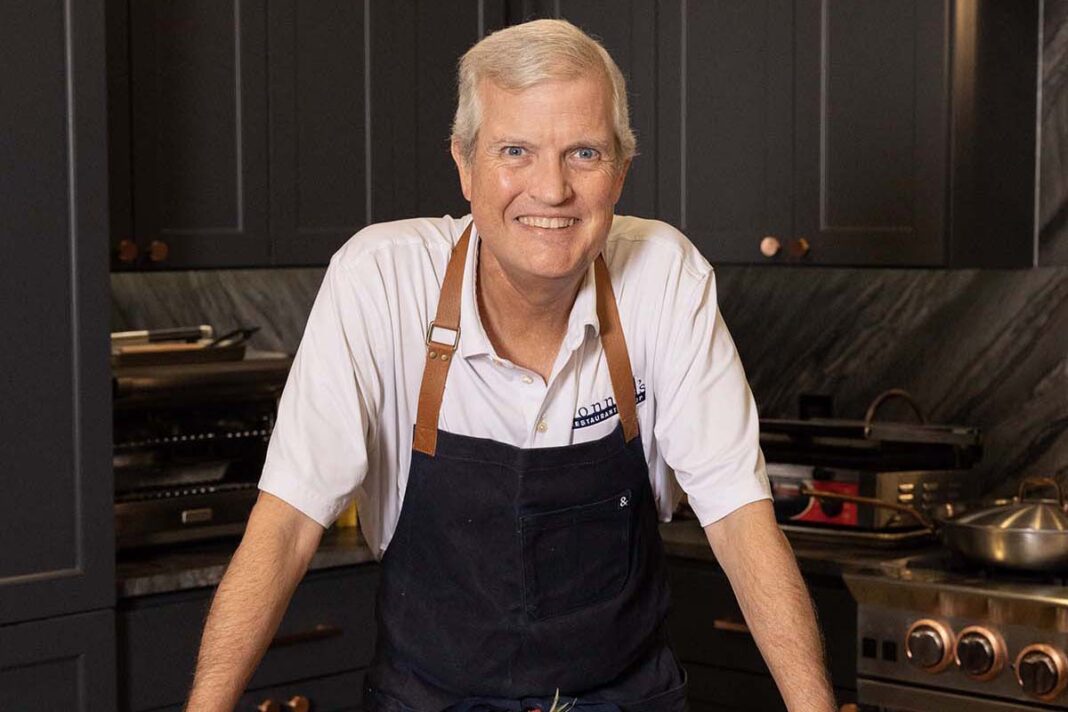
In chef and restaurateur Jon Bonnell’s home kitchen, Thanksgiving begins with a small act of accommodation: What if you don’t need a turkey?
The man behind Bonnell’s Fine Texas Cuisine, Waters Restaurant and Buffalo Bros is accustomed to feeding a crowd. His childhood Thanksgivings drew about 40 people to the family lake house, and he still regularly cooks for around 30. But for readers whose holiday gathering might fit around a much smaller table, he proposes Cornish game hens, each guest receiving a bird of their own.
“Everybody feels special,” he says.
The hens have spent the night in a brine. Now Bonnell pats them dry, explaining why moisture on the skin interferes with roasting, and fills their cavities with lemon, thyme, rosemary and sage. He works garlic and chopped herbs into softened butter, then slips generous amounts beneath the skin. There is instruction at every turn, delivered with the ease of someone who enjoys having people in his kitchen.
This year, however, there is a profound distance between the flavors Bonnell describes and what he can experience himself. After four months of surgeries and radiation for stage 3 head and neck cancer, he is in complete remission. His sense of taste, lost during treatment, has not returned.
Nothing in the rhythm of the demonstration suggests a retreat from cooking. He explains how the butter helps the skin brown, why the cavities should not be packed too tightly and how rotating the roasting pan compensates for an oven’s uneven heat. These are familiar actions, informed by years of work and by a childhood in which cooking often began outdoors.
“I grew up hunting and fishing,” he says.
His father was the improviser, ready to cook whatever Bonnell and his brother brought home: dove, quail, ducks or venison. His mother brought a different kind of assurance to the kitchen. Comfortable with demanding French preparations, she could make stocks, build a roux and follow complicated recipes to their conclusion. Between them, they gave their son both an appetite for game and an appreciation for the techniques that would help him cook it well.
“Cook what you like and what you’re passionate about,” he says.
The connection to his restaurants is direct. Bonnell’s emphasis on game and Waters’ focus on fish grew from interests established long before he considered cooking professionally.
Even so, his first career was teaching. After graduating from Vanderbilt University in 1994, he taught math and science before the early Food Network programs prompted him to consider culinary school.
The teacher remains evident as he moves through the recipe, explaining each step rather than asking anyone to take it on faith.
“The best tools you have are both your hands,” he says, mixing the compound butter.
Among his other tools, one knife has acquired particular significance. Made by Bloodroot Blades, it has a Damascus steel blade and a burled maple handle. When the maker learned about Bonnell’s cancer, he offered to move him ahead of the customary waiting list and make something especially for him. Bonnell calls it his “cancer fighting stick.”
“I’ve been collecting chef’s knives forever,” he says. “This is my favorite to use these days.”
The collection holds family history, too. His son’s custom knife incorporates the cartridge from the first deer he shot. His daughter has a knife of her own at college. Both children enjoy cooking, although Bonnell says he is not steering either toward the restaurant business.
What he does want to pass along is the knowledge. He has little patience for the idea that a good recipe ought to remain a closely guarded possession.
“I give away every recipe I’ve got,” he says. “I will never keep a secret in the kitchen.”
It is an approach well suited to the holiday he remembers. Thanksgiving at the lake house included cousins, extended family and friends who needed somewhere to go. His mother, who died in 2018, presided over the food; he helped. Now he takes on much of the cooking himself.
The hens go into the oven, and Bonnell sets a reminder to rotate them every 10 minutes. Once they are ready, there will be no elaborate carving ceremony, no host stranded at the head of the table trying to divide a turkey while dinner cools.
“Everybody can just pull their own apart,” he says.
The chef has done his part. The rest belongs to the people he is feeding.
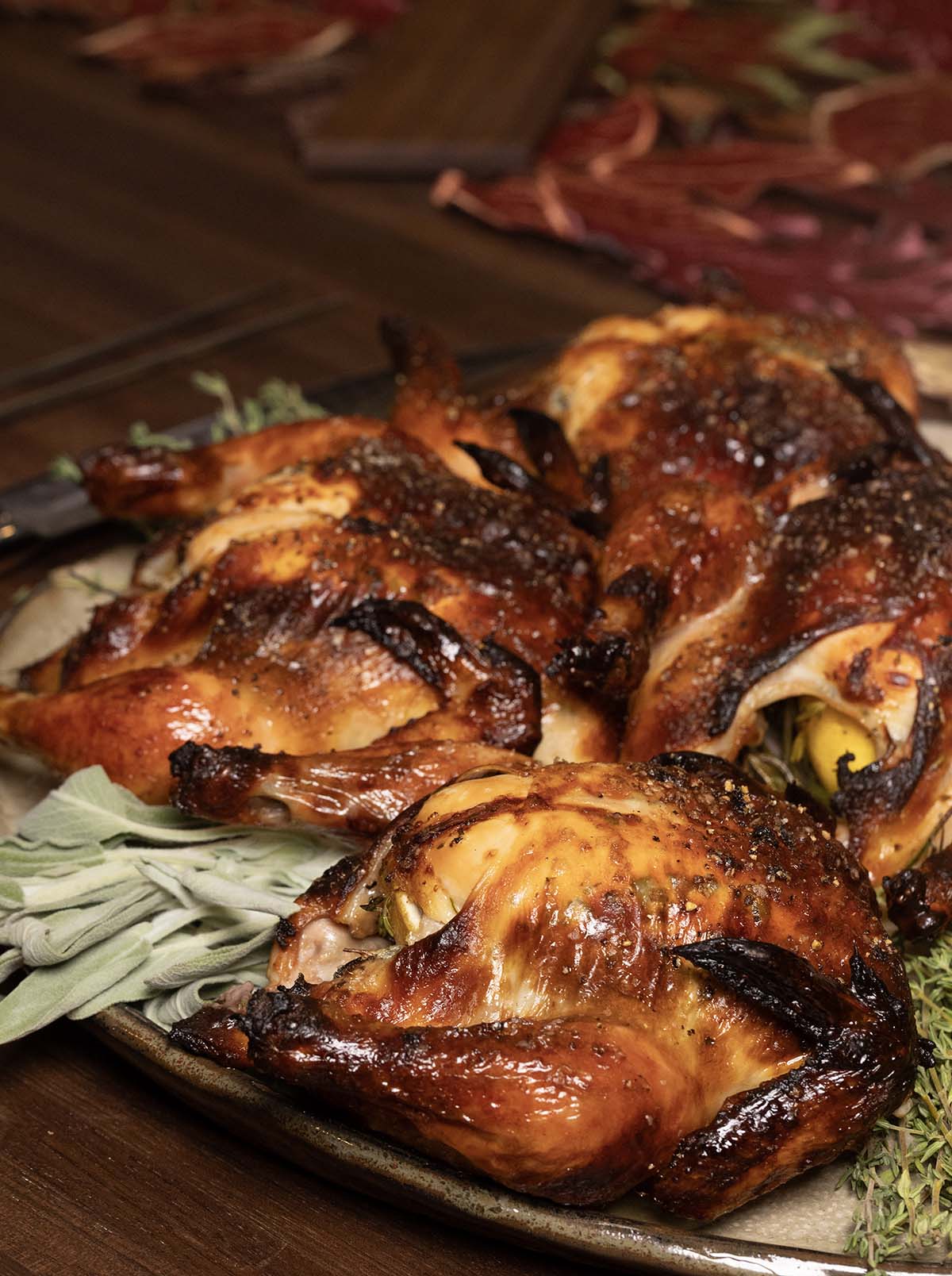
Jon Bonnell’s Roasted Cornish Hens
Yield: 7–14 servings, allowing ½–1 hen per adult
Ingredients
For the brine
- 1 gallon cold water
- 5 cloves of fresh garlic (roughly chopped)
- 3 lemons
- 1 cup kosher salt
For the bird
- 7 Cornish hens
- 2 sticks unsalted butter
- 2 cloves fresh garlic
- 1 teaspoon kosher salt
- Fresh herbs (for Fall I like to use sage, rosemary, and thyme)
For the dish
- 1/2 cup local honey
- 2 bay leaves
- 10-15 black peppercorns
Day one
Bring a few cups of the water to a boil and add in the lemons (juice them and add
in the halves after as well). Allow to boil for approximately one minute, then
combine with the rest of the cold water to bring the temperature down. A few ice
cubes can help as well. Clean and rinse the Cornish hens, then submerge in the
brine completely. I like to place a dinner plate on top to ensure that the birds stay
under the brine and do not have parts floating out. Brine the birds overnight, or at
least a few hours in the fridge.
Day of the meal
Remove the hens from the brining liquid and pat dry with paper towels, then place
them on a roasting rack. Allow the butter to soften, then chop your fresh herbs,
mince the garlic, and combine with the butter and salt. Using your fingers, slightly
separate the skin of the hens from the breast meat, but do not remove it. Shove the
garlic and herb butter liberally between the skin and the breast meat of all of the
birds. You can also slather some of the mixture on the outside of the skin.
Season the birds well with salt and pepper all over. Place a large wedge of lemon
and plenty of sage, rosemary, and thyme (yes, you can add parsley if you wish to
complete the song), leaving them all whole and on the stems inside the cavities of
each bird. Roast the hens at 400–425°F in a convection oven for roughly 45
minutes, turning the pan every 10 minutes or so for even cooking. The
important part is not how long you cook them (which will vary depending on bird size and oven type), but the overall internal temperature of the birds, which should
reach 160°F before you remove them from the oven. Once they come out, be sure
to let them rest for at least 10 minutes before trying to serve. They can be placed
whole on a beautifully garnished serving tray or cut in half (poultry shears can help
with this). One half to one full bird is a great portion for adults when serving
Cornish hens. A wonderful traditional gravy can also be made with the pan
drippings and all of the excess butter that you can collect from the roasting pan
while the birds are resting.
Jon Bonnell’s Restaurants
Bonnell’s Fine Texas Cuisine
4259 Bryant Irvin Road,
Fort Worth, TX 76109
817-738-5489
bonnellstexas.com
@bonnellstexas
Waters Restaurant
301 Main St.,
Fort Worth, TX 76102
817-984-1110
waterstexas.com
@waterstexas
Buffalo Bros TCU
3015 S. University Drive, Fort Worth, TX 76109
817-386-9601
buffalobrostexas.com
@buffalobros
Buffalo Bros Sundance Square
415 Throckmorton St.,
Fort Worth, TX 76102
817-887-9533
buffalobrostexas.com
@buffalobrossundance
Buffalo Bros Burleson
139 W. Ellison St., Suite 101
Burleson, TX 76028
682-841-0062
buffalobrostexas.com
@buffalobrosburleson