


By Hannah Barricks
Photography courtesy of Face Foundrié
A high-frequency wand sits in a rotating crystal caddy next to my bathroom sink.
It’s one of several skincare tools that have gradually taken over my bathroom counter over the past few years. Alongside them sits an ever-changing collection of serums, moisturizers and cleansers, each promising brighter skin, fewer fine lines or a healthier complexion. Like many women, I’ve embraced the idea that professional skincare no longer has to happen in a spa. Between at-home devices, medical-grade products and an endless parade of miracle ingredients filling social media, we’ve never had more ways to care for our skin without leaving the house.
So when I booked a HydraFacial at Face Foundrié’s new Southlake location, I wasn’t looking for another product recommendation.
I wanted to know what a professional esthetician could still offer that my bathroom couldn’t.
Walking into the newly opened Southlake facial bar, I was struck by how different it felt from the traditional spas I’d visited in the past. Instead of dimly lit treatment rooms tucked behind heavy doors, the space felt bright, modern and approachable. Treatment bays are separated by floor-to-ceiling curtains rather than walls, creating privacy without making the experience feel exclusive or intimidating. It struck me as a fitting reflection of Face Foundrié’s philosophy: professional skincare designed to fit into everyday life rather than reserve itself for special occasions.
That question followed me into one of the treatment bays, where Bailey Muncrief, Face Foundrié’s Southlake manager, greeted me with an easy smile and casual conversation before broaching the status of my skin.
Instead, she asked about me.
What changes had I noticed in my skin over the last few years? Where was I experiencing dryness? What was I already using? Had anything changed recently?
The conversation felt less like a consultation and more like someone trying to understand the story my skin was telling.
As we talked, I admitted something I hadn’t fully realized until I said it out loud.
Somewhere after having children and settling into my mid-30s, my skin had quietly changed.
I just hadn’t changed with it.
As Bailey looked more closely, she noticed things I hadn’t. While I associated breakouts with oily skin, she explained that dehydrated skin can also have a weakened skin barrier, creating an entirely different set of challenges. We talked about hormones, stress, Texas weather and the way our skin naturally evolves over time. Every answer seemed to replace an assumption I’d been making for years.
By the time our consultation ended, I realized I’d spent far more time buying skincare than understanding my own skin.
Only then did the facial begin.
When I asked Bailey how she explains a HydraFacial to someone who’s never had one before, she smiled and described it as a quarterly reset for your skin.
That description stayed with me throughout the treatment.
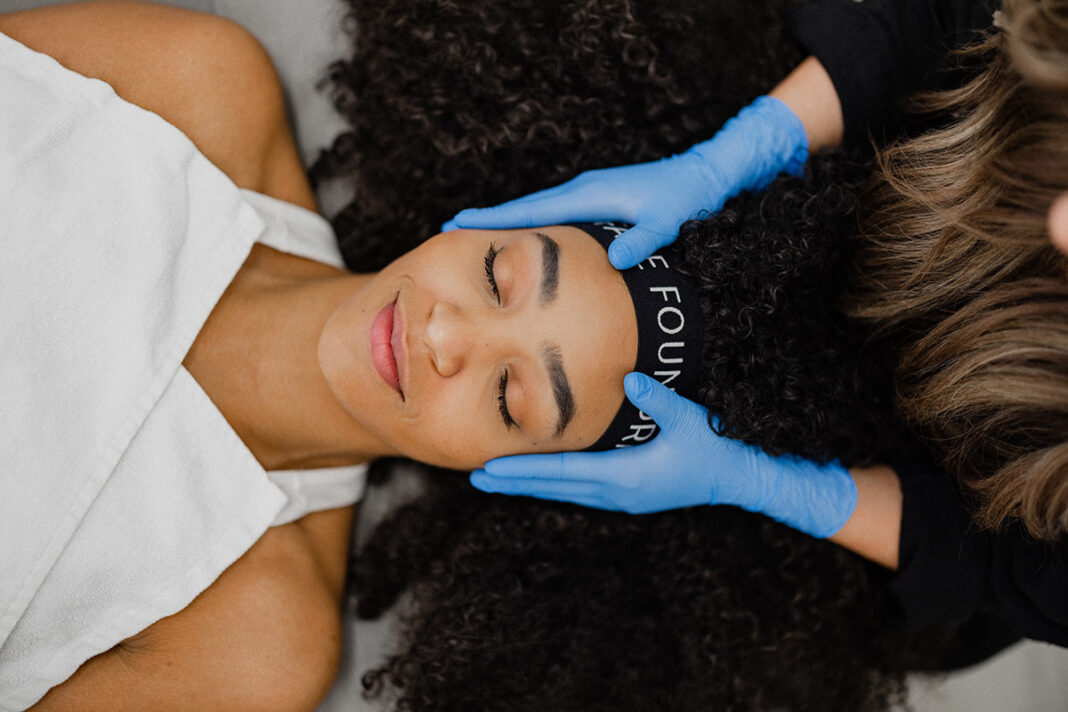
The facial begins with cleansing and gentle exfoliation before moving into hydradermabrasion, which simultaneously lifts away dead skin and impurities while infusing the skin with hydrating serums. The suction was gentler than I expected, more satisfying than uncomfortable, and Bailey narrated every step as she worked. She explained why she was choosing certain boosters, what she was seeing in my skin and how each stage built on the one before it. Rather than quietly moving from product to product, she invited me into the process.
I found myself asking questions almost constantly.
Why did my skin feel dry and still break out?
Why had my complexion changed so much in the last few years
Why did certain ingredients seem to stop working?
Each question led to another conversation, and before long, I realized I wasn’t simply receiving a facial.
I was getting an education.
Somewhere in the middle of the treatment, it hit me that the facial itself wasn’t what made the appointment valuable.
The conversation was.
Like many women, I’ve spent years trying to solve skincare concerns by buying another product. A serum replaces another serum. A cleanser gets swapped out because someone online swears it’s life-changing. Before long, the bathroom cabinet fills with expensive bottles, each purchased with the hope that this one might finally be the answer.
What Bailey offered was something none of those products ever had.
Context.
Before I left, she recommended EltaMD UV Skin Recovery Red Color Correcting Green Tint Broad-Spectrum SPF 50 after we talked about the redness in my complexion and how often I preferred a natural look. I bought it, not because I felt pressured to, but because by then she’d earned my trust. The recommendation felt tailored to my skin rather than part of a standard retail routine.
Several weeks later, it’s still the product I reach for first.
Since my facial, I’ve covered community events, attended social gatherings and spent afternoons running errands wearing little more than that redness-correcting sunscreen instead of foundation. It evens out my complexion just enough that I don’t feel like I need much else. For someone who rarely leaves the house without makeup, that’s probably the biggest compliment I can give the recommendation.
I’m also still using the products Bailey sent me home with to see whether the results extend beyond the immediate post-facial glow. Anyone can leave a treatment looking refreshed. What interested me more was what happened a week later. Or three weeks later. Would my skin continue responding differently once real life resumed?
So far, it has.
That doesn’t mean my high-frequency wand is headed for the donation pile, or that I’ll stop trying new skincare products. If anything, I enjoy skincare more now than I did before.
The difference is that I’m shopping with a little more intention.
The older I get, the less interested I am in buying more skincare and the more interested I am in understanding the skin I already have. Products will continue to evolve. Ingredients will come and go. Another miracle serum will inevitably appear next month, promising to do what the last one couldn’t.
What I can’t order online is someone who knows enough to look at my skin, ask the right questions and explain what they’re seeing.
It turns out that was what I had been missing all along.
Not another product.
Not another device.
Just a better understanding of the face in the mirror.