


By Joy Donovan
It was always about beauty.
When the club formed in 100 years ago, Fort Worth’s population had surpassed 100,000 with people drawn here by the stockyards, the oil business and railways. Even as downtown was bustling, the city’s miles of unpaved streets were examples of what newcomers found here.
As the Star-Telegram’s masthead proclaimed, the city was “Where the West Begins.” The town was going through a transformation. Yes, it was Cowtown, but the town was booming. Sensing the possibilities, a group of women stepped up to polish the rough edges and to transform it into a beautiful city.
On April 1, 1926, those women gathered to create the Fort Worth Garden Club. Now, 100 years later, the club is celebrating its centennial as a thriving club of 675 with a waiting list to join of more than 200. That first meeting set in motion decades of civic care, countless unheralded acts that transformed Fort Worth’s public spaces during the past century.
This year and especially this month, its busy members have taken time to celebrate the occasion. They enjoy a thriving club, especially in this era when other clubs are dwindling due to competing priorities and a lack of interest, and with 100 years of accomplishments.
A member celebration with a champagne toast was held in November in the Fort Worth Botanic Garden’s Japanese Garden. The club’s annual flower show features a centennial theme, an invitation-only gala is planned for April 18 at the Fort Worth Botanic Garden, and the club will publish a hardcover coffee-table book chronicling its successful history.
The club’s success has included not only street beautification, but also park enhancement, tree plantings, greenspace advocacy and much of what makes The Fort Worth Botanic Garden bloom so proudly today. That legacy of caring for the community reaches back 100 years this month.
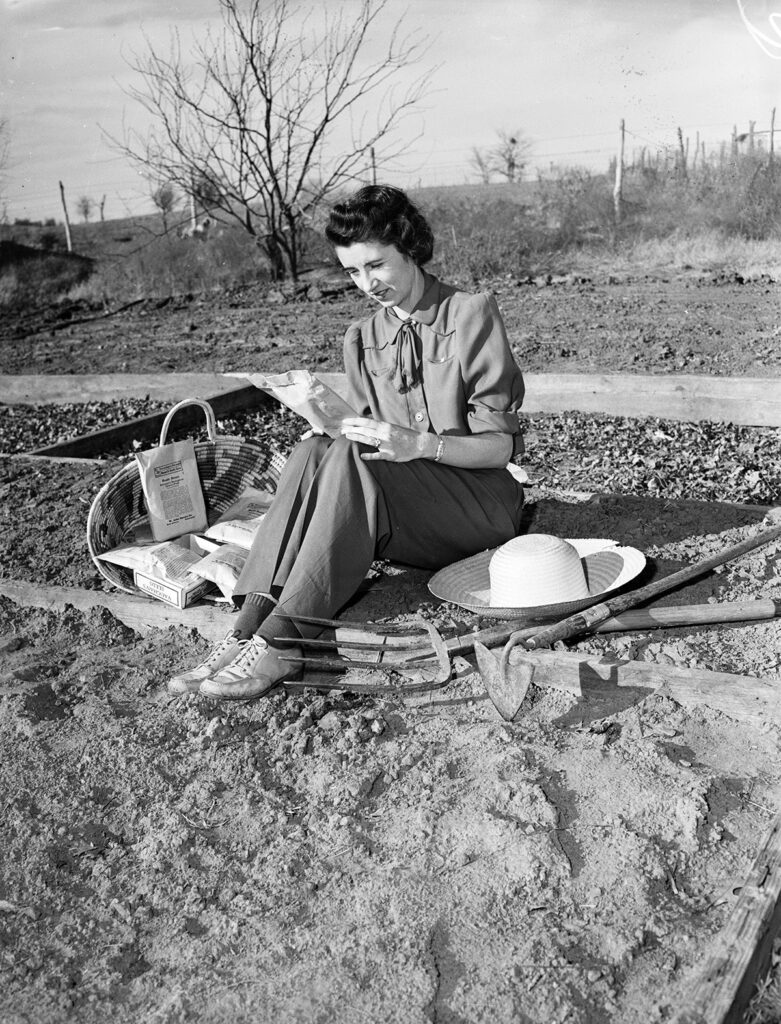
On April 1, 1926, a group of women formed the Fort Worth Garden Club. It began shaping the city — an adopted home for some — into the beautiful environment they envisioned for their community. Just six years after winning the right to vote and decades before they could hold credit in their own names, these women stepped forward with clear intentions. The club’s first president, Mrs. Ben O. Smith, as Frances Portwood Smith was then formally referred to, made it clear.
“The purpose of the club will be to beautify and keep beautiful the yards of the homes in the city,” she was quoted in the Fort Worth Star-Telegram as saying.
Within just eight months, the club had held its first flower show at Anna Shelton Hall of the Women’s Club of Fort Worth, launching a tradition that the club enthusiastically continues today.
Not only did the flower show, with its admission of 25 cents per person, entertain the community, but it also financed its first beautification project, landscaping the women’s club building.
The garden club’s 16 original members, some suffragettes, some business-minded pioneers and some East Coast transplants set a standard that still carries the club forward. It’s a legacy built on civic pride, clear purpose and the belief that determined women could shape a city.
Today, Fort Worth benefits from 10 decades of the Fort Worth Garden Club’s charitable works. Flower shows are a long-standing tradition, but there’s so much more that the indefatigable members have contributed to Tarrant County. Much of what its members have provided, such as the line of bald cypress trees they planted in 1968, now beautifying Trinity Boulevard, is taken for granted today as just a part of Fort Worth.
That legacy, though, was intentional.
Guided by the club’s mission statement “…to cultivate a broader knowledge of gardening, horticulture, and design; to advocate for the environment; and to support the Fort Worth Botanic Garden,” the club built traditions of beautification achievements.
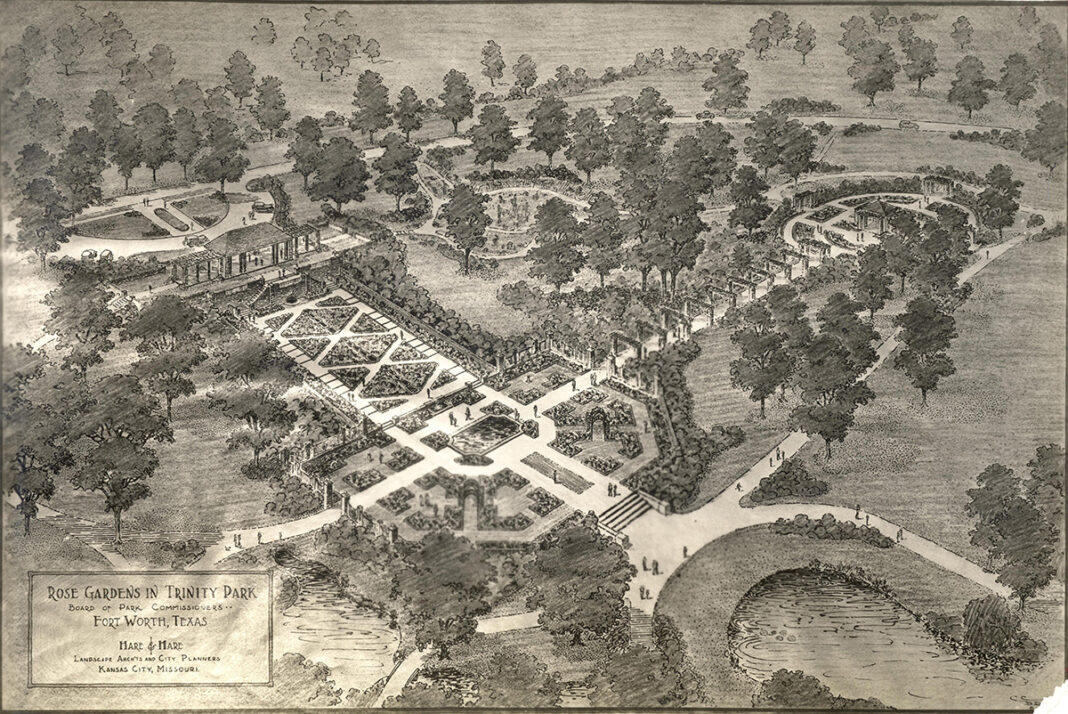
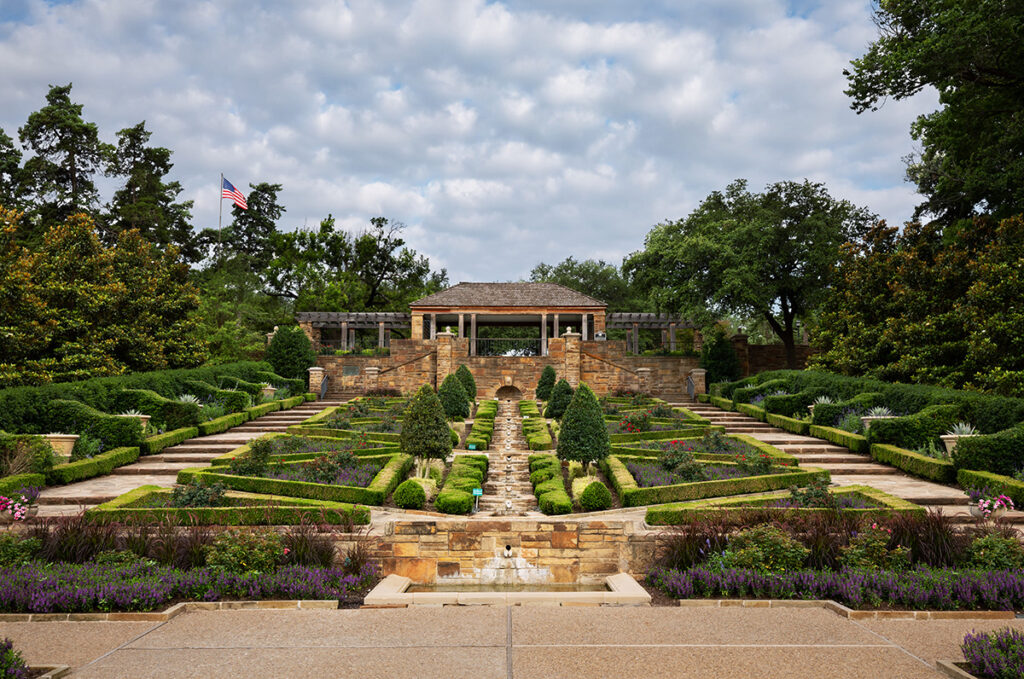
Easy to see are the visuals within the city’s public garden. Even as the former Rock Springs Park was being transformed into the Fort Worth Botanic Garden, the first municipal garden in the state, the garden club was influential in hiring the renowned landscape architecture firm of Hare & Hare to plan it. For example, the club has supported the garden’s iconic rose garden, not only during its creation amid the Great Depression but also in this millennium through its restoration. Yet far more has been accomplished.
The Fort Worth Botanic Garden’s own staff has been sustained throughout the years with the support of the garden club, and that support has never wavered. In the past, club volunteers managed the botanic garden’s event rentals to bring revenue to the massive public garden. Now, club volunteers often lead tours of the gardens and even work alongside the professional staff on activities such as supporting the world-renowned begonia collection and the Celebramos Marigold Carpet Planting each fall.
This public-private partnership between the city and the Fort Worth Garden Club has succeeded beyond expectations. With its characteristic vision for the future, the club raised funds for 14 years to advance the construction of the larger complex of the conservatory, the botanic garden center, and the lecture hall, bringing the destination garden to life and expanding the experiences. Through the club’s donations to the beloved Japanese Garden, specialty gardens and acclaimed art installations, the organization has helped make the greater garden a popular destination.
“The garden club, because of its dedication and service to the Botanic Garden, clearly was an institution that wanted to be good stewards of this natural, educational and life-renewing asset,” said Richard Zavala, the city’s former parks and recreation director. In that role, he collaborated with the club for decades and admired its commitment to supporting the municipal garden and demanding excellence.
“When you walk into that place, we all see what a beautiful setting it is, and we enjoy the space. The city saw the club as long-term stewards when they said we want to build this for the city.”
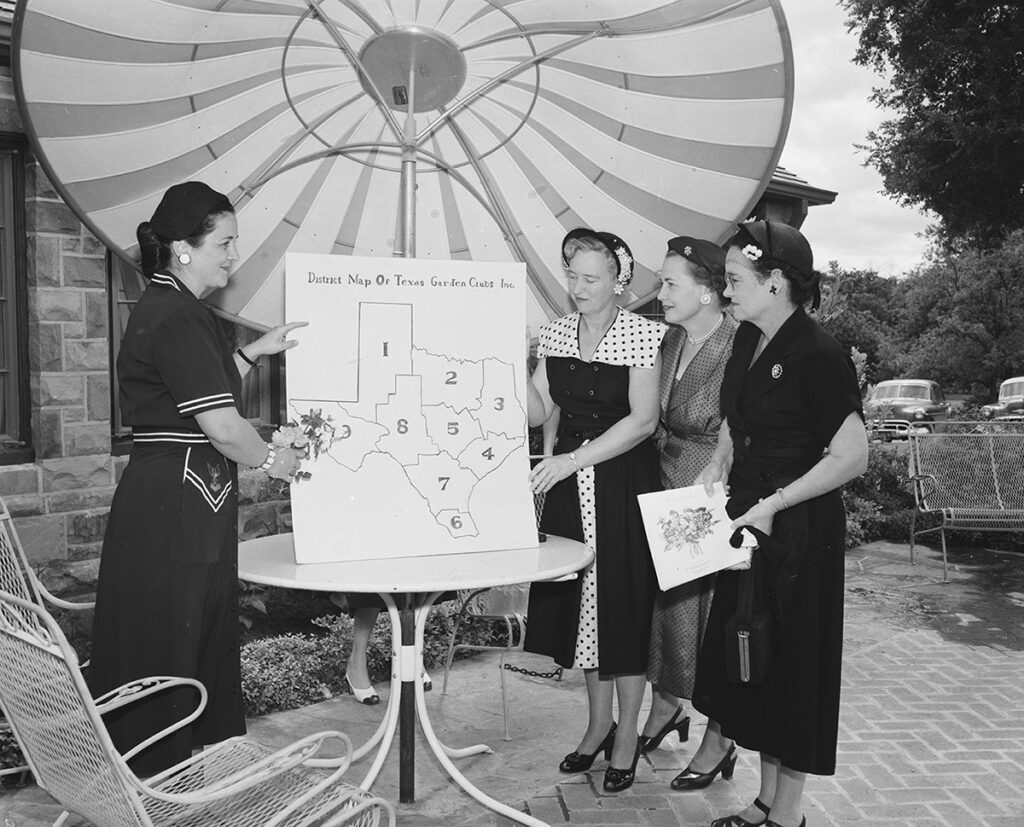
The club’s influence extends beyond a single site. Even before it was popular, garden club members were championing green spaces. As early as the 1930s, club members worked to support beautiful highways as the cowboy culture of horses and wagons gave way to automobiles. As early as the 1950s, the club promoted conservation, and by the 1970s, its members marked Arbor Day with tree plantings. Those early ecological steps have taken root as significant events, including an annual three-day tree-giveaway. Club members also had the foresight to purchase the herbarium of Texas botanist Albert Ruth. The collection now resides at the Botanic Research Institute of Texas as a reference for scientists and students.
There’s beauty, too, in education.
Monthly, the club meets at the Fort Worth Botanic Garden to hear educational speakers on everything from conservation to horticulture to landscape design. Club members also make beautiful commitments to sharing their knowledge with others. Some members volunteer to lead flower-arranging sessions at area senior living facilities. Others spend Saturdays conducting monthly Girls Nature Workshops, introducing girls to horticulture through hands-on activities, in hopes of inspiring another generation of plant lovers.
Beautiful friendships are gathered along the way, too. Whether through committee work, taking one of the club’s many pilgrimages to enjoy gardens or sharing a table at a fundraiser where celebrities such as Martha Stewart or Nanette Fabray spoke, the plant lovers connect. Often, sponsoring someone for membership is a way to introduce a newcomer to Fort Worth, or a “welcome to the family” gesture for a soon-to-be daughter-in-law. The meetings and activities provide a social outlet for retirees and connecting members who share similar interests.
The club’s latest achievement will make its debut as the Fort Worth Garden Club begins its 101st year. In November, the Barker Martin Family Garden, a long-anticipated project, will open to the public within the Fort Worth Botanic Garden. In addition to this very visible project, the club still sustains the beautiful spaces with funding for the botanic garden’s needs and to reward the beauty within the city with the Fort Worth Beautiful Awards, established in 1987 in cooperation with the city, to recognize landscaping in all parts of the city, including businesses, schools and neighborhoods. The 2025 winner was, in fact, the city of Fort Worth, illustrating that the club has made a positive impact.
“One hundred years ago, the ladies worked to spread the beauty across the city,” said Taddie Hamilton, the club’s president from 2014 to 2015. “We started with it in the center of Fort Worth, and it has spread to all parts of the city to share the beauty and to inspire people to bring that beauty into their homes. By doing that, we’re showing our children what to do, too, and sharing that knowledge with the next generation.”