


Story and photography by Shilo Urban
An ocean of ochre sand undulates all the way to the horizon, with endless dunes in every direction: the Sahara Desert. My camel lumps forward with steady steps in the ever-shifting sandscape. We follow a Berber nomad in a flowing indigo robe. His people are called the Blue Men of the Desert, and they’ve caravaned across these sands for a thousand years.
We reach the camp — a smattering of simple tents — where we’ll rest for the night, out of reach of the modern world. The 500-foot-tall dunes that surround us seem to stand still, but they are creeping forward, bit by bit, blown by the wandering wind. We feast on chicken tagine with olives and lemon, then gather around the fire to listen to stories of genies, lingering late as a Berber softly drums.
I sleep in the open under a riot of stars, and wake to a desert awash in pastel light — only then realizing that I’ve been cuddling with a cud-covered camel saddle all night. I shake the sand out of my socks and start climbing to the crest of a nearby dune, unaware that I’m in for the toughest workout of my life. It’s miles taller than it first appeared. At the top, I fall over sideways in the sand. A herd of wild goats runs through our camp far below, ant-sized specs in a dusty, sunbaked sea.
This is the Morocco I’ve always imagined, but I discover much more than desert in this enigmatic land. Green patchwork farms blanket the rolling hills of the north, and I fill my backpack with dates and fresh figs at roadside stands. Olive groves and vineyards thrive.
Shepherds graze their flocks among feathery purple wildflowers, and storks nest on marble columns in crumbling Roman ruins.
I’m making my way to Fez, a medieval city I find frozen in time. Fez’s medina, the dense historical quarter, is a maze-like warren of covered corridors and secret passageways that no traveler could navigate without a guide. Tilting, serpentine streets — alleyways, really — have barely enough room to pass a donkey. Balek! Balek! Get out of the way! I learn these words quickly — for the donkeys do not stop, loaded with leather scraps or rose bouquets or bundles of agave silk.
Shops tucked inside stone archways sell brass lamps, just-squeezed orange juice, frankincense, shoeshines, spices, copper cups, camel heads, nougat candies, caskets, and spleen (for sandwiches, of course). One man has a basket of live snails. I glimpse lemon trees in secluded gardens and run my hand over carved cedar doors. Cats with their kittens dodge children on the loose. We eat sweet chicken pie in a beautiful courtyard bistro and see the oldest university.
The medina is a mesmerizing mosaic, a labyrinthine museum that’s very much alive, with 150,000 locals, copious donkeys, zero cars, and a few bewildered tourists like me.
Farther south in Morocco, we climb the Atlas Mountains toward snow-dusted peaks. No roads run to the little village of Aroumd, so we must hike to our ancient guesthouse. A magnetic mountain panorama pulls me up the path to our destination, where mint tea is waiting when we arrive. It’s a frigid night, and I sleep under three heavy wool blankets, cud-free this time. I checked.
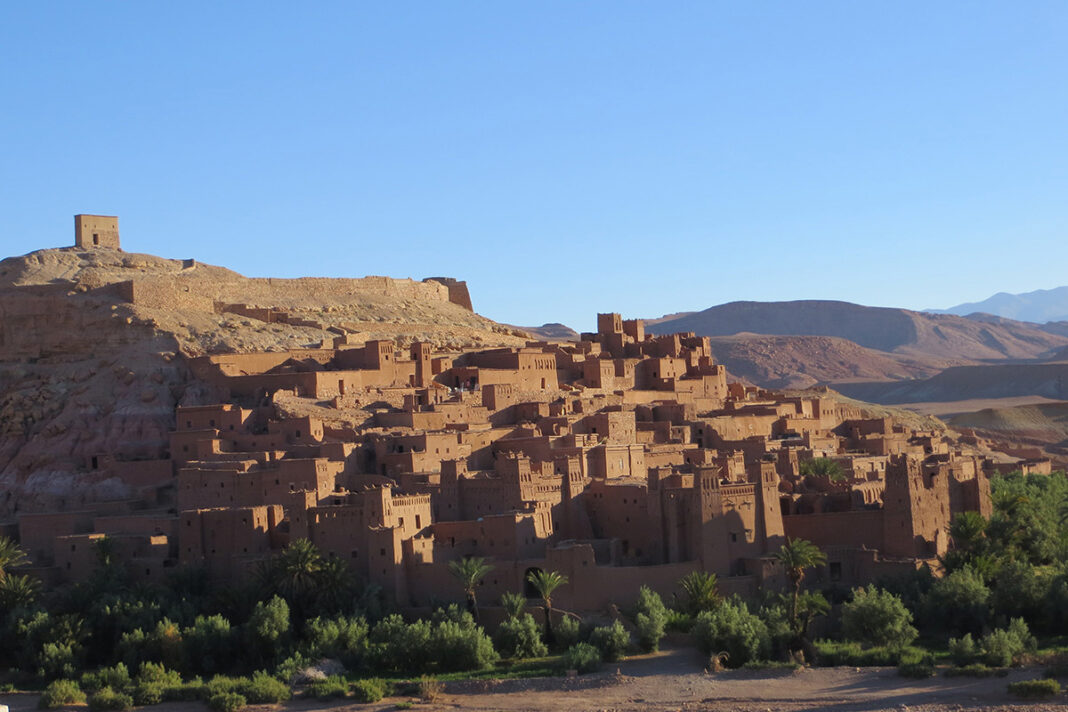
To the east, I gawk in wonder at red-rock Todra Gorge, whose near-vertical cliffs stretch higher than the Empire State Building — yet have just 30 feet between them. Cafes are crammed in the crevices. At the fortified village of Aït Benhaddou, I clamber up to the kasbah on top; the whole scene looks strangely familiar. Our hotelier (“Call me Mr. Hollywood!”) tells us why: The citadel has appeared in dozens of shows, including Gladiator and Game of Thrones. Aït Benhaddou so beguiles me that the terraced, tumbling village is now painted on my bedroom wall.
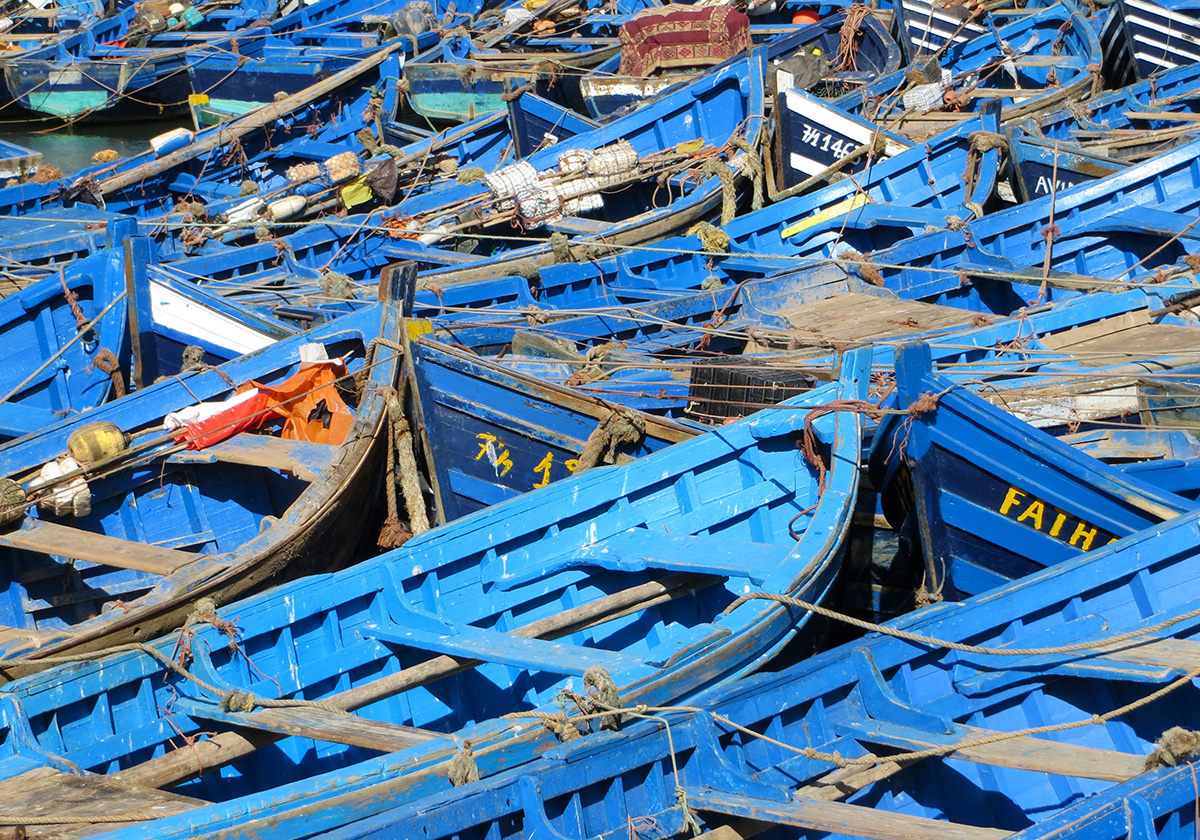
But most enchanting of all was Essaouira, an artsy enclave with an ancient soul. Part fishing harbor and part boho hideout, the laid-back beach town is located on Morocco’s wind-whipped Atlantic coast. Waves smash against the ramparts. Bright blue boats bob up and down. A salt-kissed breeze mingles with the resinous perfume of tree oils and the tink-tink-tink of artisans at work.
We feast on fresh fish and fine wine at low tables, reclining on jewel-toned cushions. Colored glass lanterns dangle above. Essaouira’s alluring boutiques and bazaars are a fever dream I cannot resist, and I succumb to a wood-mosaic gem box, a poofy round footrest, painted platters, Berber bracelets — and a handmade leather duffle to tote it all home.
Yet there is so much more to Morocco, whose treasures are not flaunted but stumbled upon: the snake charmers in Marrakesh, the French pastries in Casablanca, the picnic-turned-dance party by the roadside stream. It is a land of hidden doorways and candle-lit nooks, whispered adventures and drums in the desert, and a sense of enduring mystery as immeasurable as the Sahara sand.