

By Hannah Barricks
Photography by Thanin Viriyaki
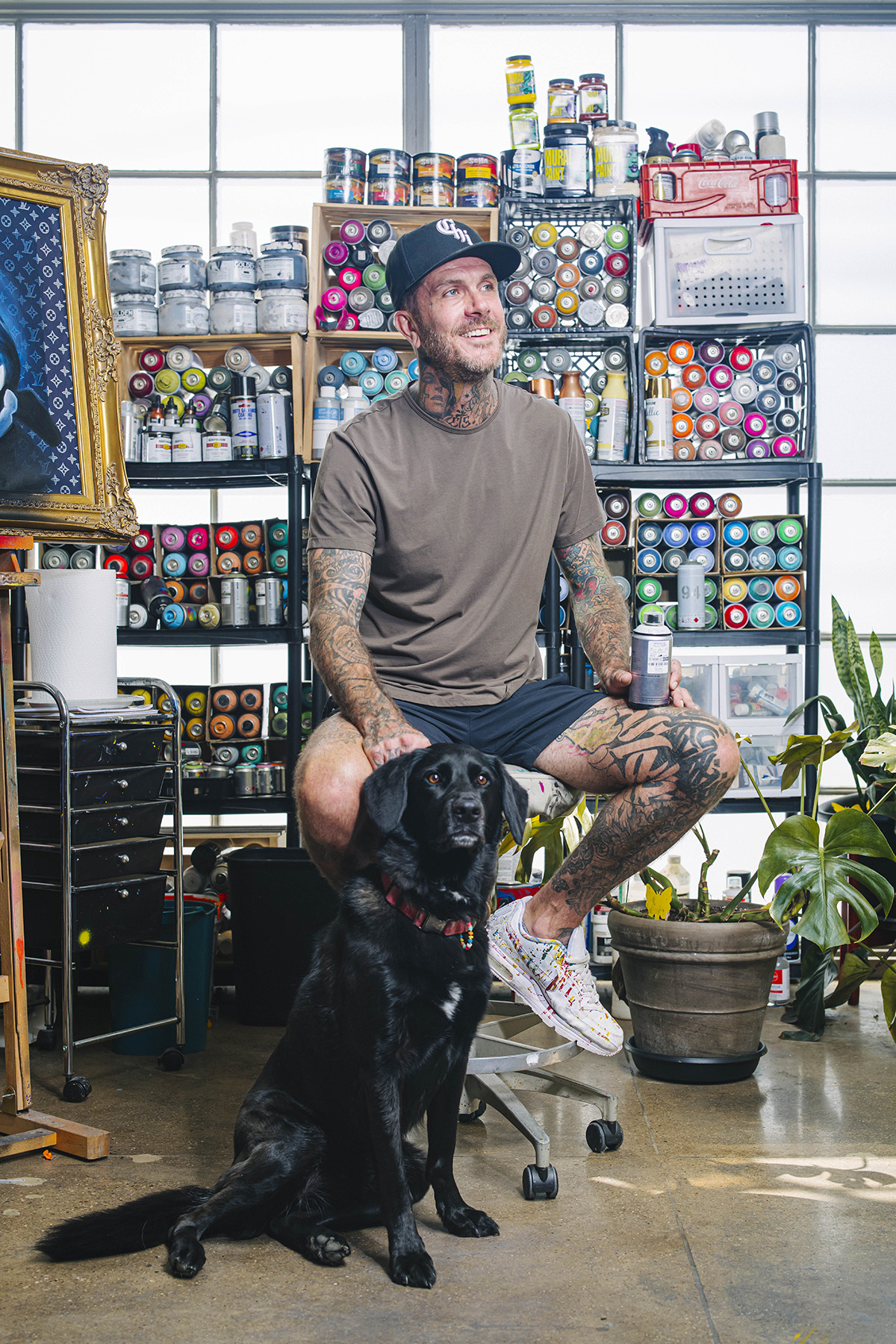
Bugsy is the first to greet visitors at a two-story studio off Main Street in Dallas. He’s a dog, and a welcome sight to a misplaced Fort Worthian in the Big D for the day. After pleasantries, Bugsy brings his guests inside, where dozens of eyes receive them, a piercing gaze from the wall, accentuated by a Swarovski crystal at its center. The eyes are only one part of Rudy Hetzer’s multimedia portraits, a Dallas-based artist whose studio Bugsy butlers for, but they make an impact. The duo are preparing for Hetzer’s first solo exhibition, “Face Value: Where Eyes Speak,” at the Gallery at Bowie House on Aug. 3, and these pieces in the studio will be a part of it.
“This is the first time it’s all mine,” Hetzer says. “Where I’ve had the freedom to see my vision come together completely.”
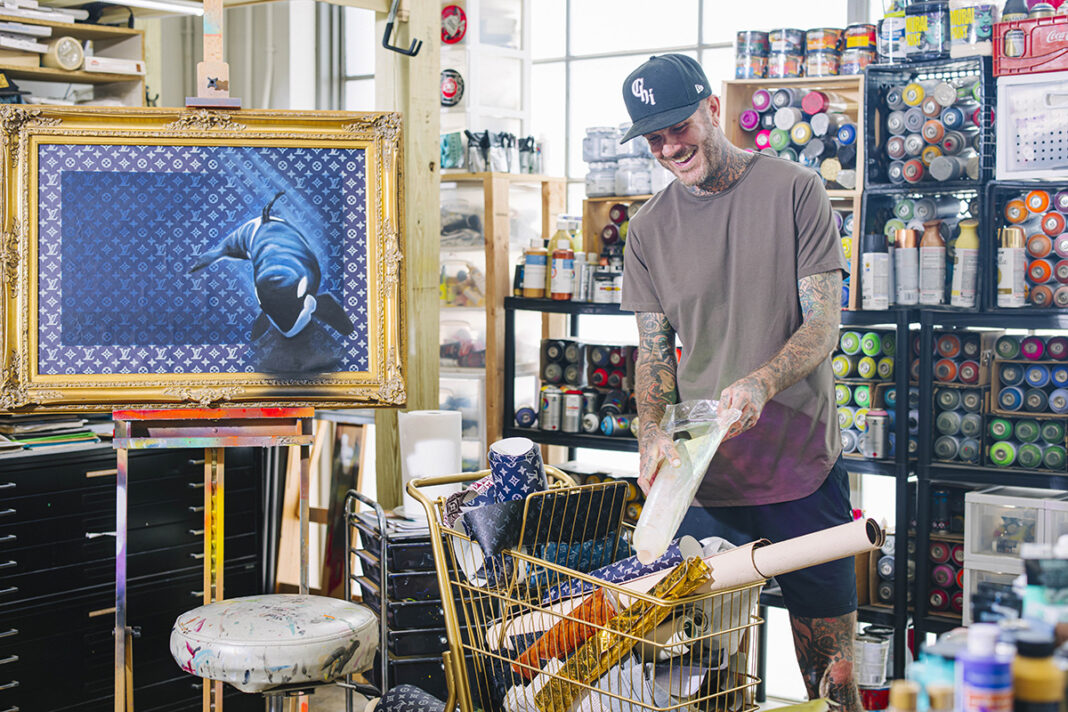
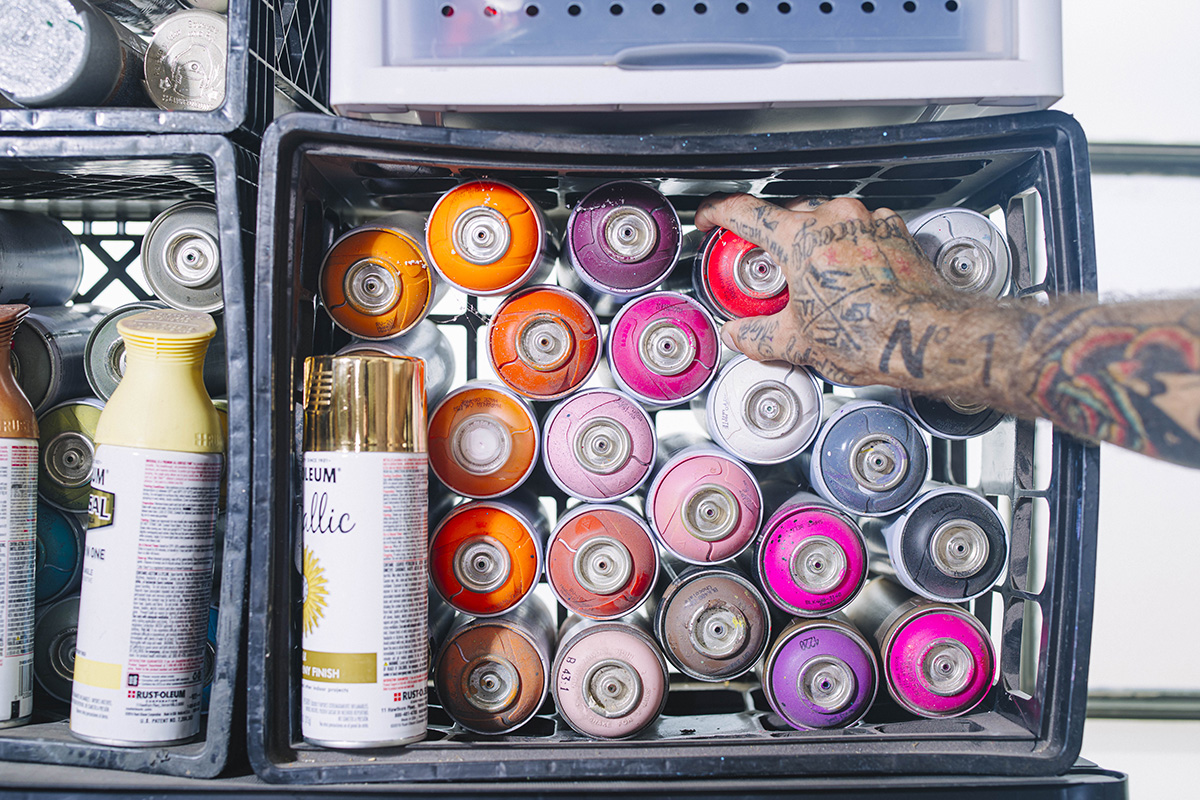
The artist is seated on a stool in front of cubbies filled with spray paint. Large canvases cover the studio’s white walls, some at least 5 feet by 5 feet, with thick layers of impasto framing the subject inside. To the right of Hetzer are smaller canvases with images of ocean life painted on repurposed Louis Vuitton vinyl. One sits unfinished on his easel, a killer whale circling the perimeter of its designer prison. The whale is intimidating within its deep blue square, its shadow frozen beneath it, but somehow the image feels static.
These paintings are also part of “Face Value,” and Hetzer shares that the whales, sharks and other oceanic wildlife are symbols of different investors, something he has learned a lot about as a member of the contemporary art crowd, but he has never felt too serious about “symbolism.”
Hetzer is an artist, and that is his goal. He’s also the first to admit his journey to Bowie House began unconventionally. A skateboarder from Naperville, Illinois, outside of Chicago, Hetzer was rebellious then and now, grabbing a can of spray paint one day to try his hand at street art.
“My work in those days was not very good,” he laughs. “Probably closer to vandalism than anything. But that’s how it started.”
Hetzer’s early “scribbles” gave way to years of tattooing, mural work and eventually a career owning Dallas Tattoo Company. He spent 18 years ink-deep in a medium he describes as “compulsive — bridging art and permanence with raw immediacy.” Tattooing, he says, taught him discipline, confidence and the importance of linework. It also taught him detachment.
“Murals get painted over. Tattoos walk out the door and you’ll never see them again,” Hetzer says. “So there’s this healthy detachment. Once a piece is done, it’s done. I get what I need from it, then I move on.”
That mindset — make, learn, release — became central to Hetzer’s artistic philosophy. He’s not chasing perfection, he says, but pursuing what he calls “the quest.” It’s the drive to constantly improve, like an athlete repeating drills to refine muscle memory.
“The journey is the whole point,” Hetzer says. “That’s what makes art intriguing.”
His paintings show the result of that evolution. His compositions are bold, layered and tactile. Some, downright heavy. Hetzer employs impasto, sometimes building it around paper towels and other materials, to create shapes and texture around a central image that begs spectators to examine it up close.
“Come feel it,” he says. “I want people to physically engage with the work. To feel like they could reach out and touch it.”
But still, it’s the eyes that stop you in your tracks. “Eyes are everything,” Hetzer says. “They’re the gateways to the soul. You can have everything else proportioned perfectly, but if the eyes are off, the whole thing falls apart.”
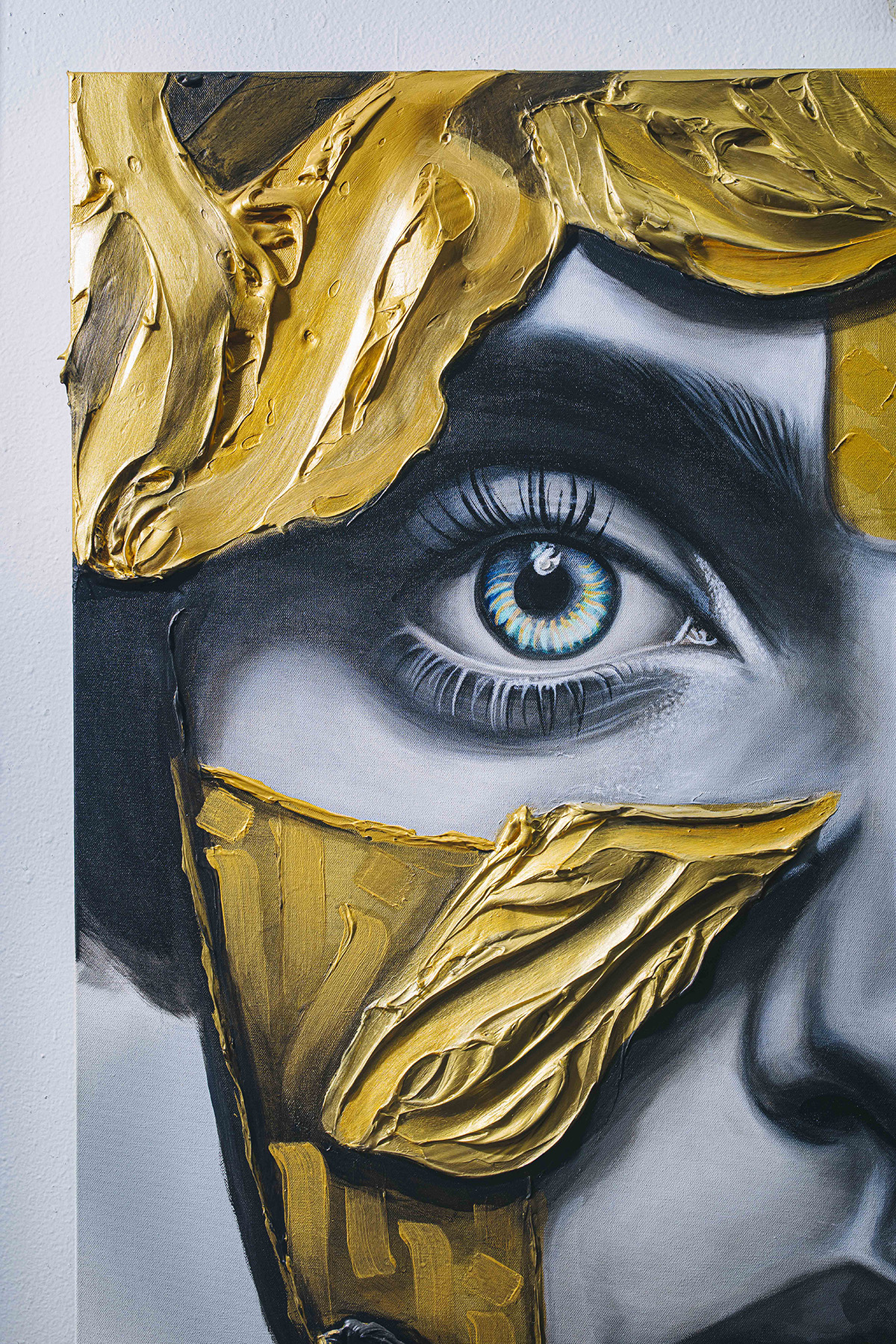
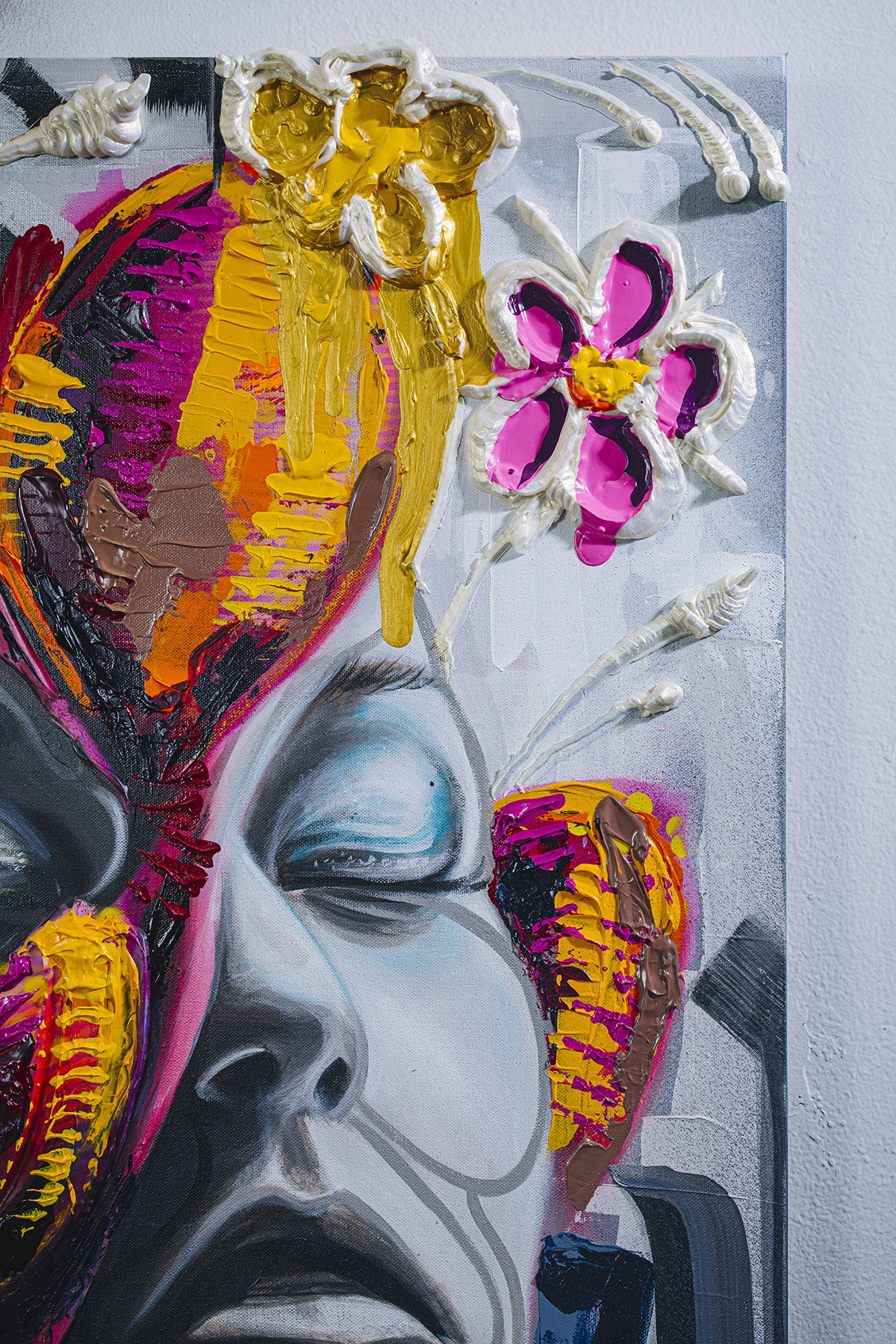
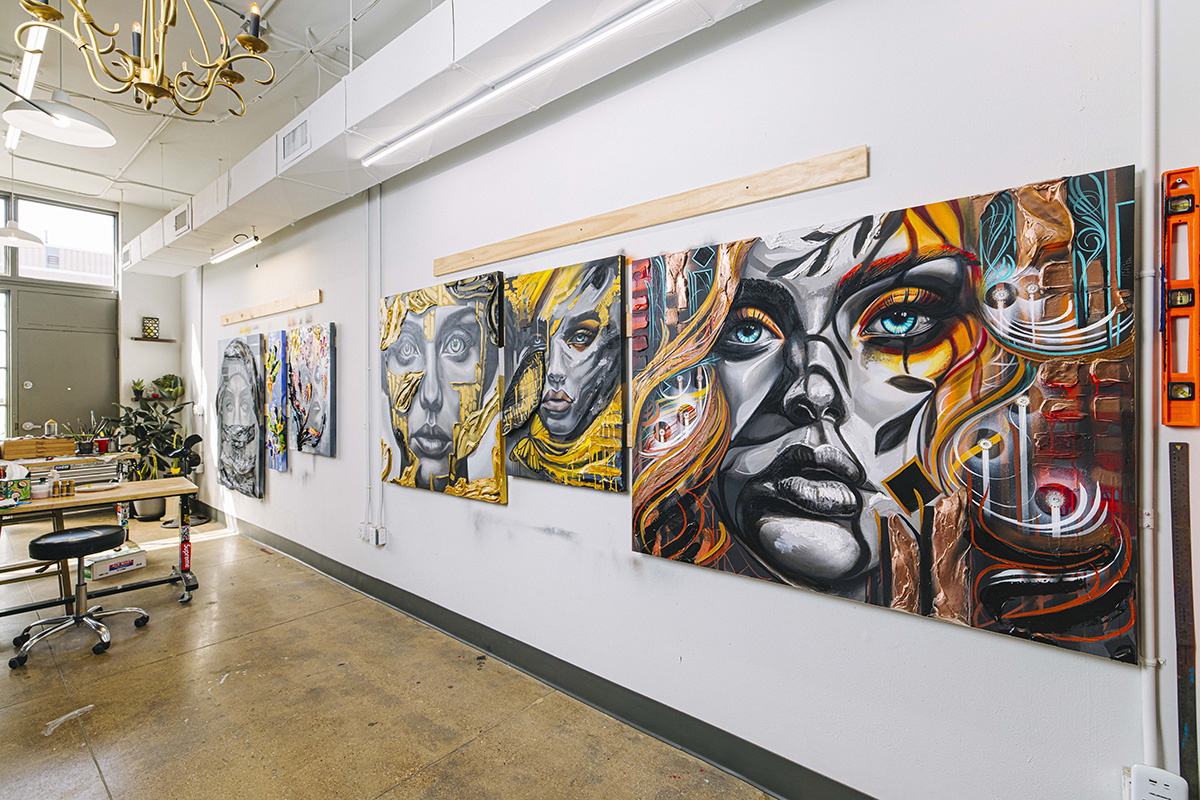

Though initially difficult for him to master, eyes have become a calling card for Hetzer’s work — direct, emotionally charged and intimate. In “Face Value,” each portrait locks onto the viewer with a presence that’s hard to shake.
Hetzer uses AI-generated images as reference points for the female subjects in his work. “I feed in parameters to create neutral, emotionally flat models,” he explains. “It avoids the attachment that comes with painting a real person. It keeps the subject ambiguous, open.”
Many of the portraits focus on the female form, which Hetzer calls “a universal beauty.” He’s quick to clarify that beauty, for him, isn’t about gender or perfection, but resonance. “There’s something about the curve of a shoulder or the shape of an eye that speaks to people,” he says. “It transcends background or belief.”
Although his work has transitioned from skin to canvas, Hetzer views tattooing and painting as siblings in the same creative family. “Tattooing is just another medium, like paint,” he says. “Social media has elevated the public’s understanding of quality tattoo art, and that’s crossed over into how I approach my canvas work.”
His background in graphic design also plays a role, particularly in how he balances composition and negative space. “It’s all layers,” he says. “Tattooing, graphic design, painting — it’s about what you choose to reveal, and what you hide.”
Resisting outside influence, Hetzer remains entirely self-taught, learning through experimentation and by studying technique. He credits his mother, a schoolteacher, and his father, a chemical engineer, for shaping his worldview. “They showed me that creativity isn’t limited to art,” he says. “It’s in how you cook, how you solve problems, how you teach.”
Now, with the tattoo studio closed and a contemporary art chapter unfolding, Hetzer is full steam ahead. His solo exhibition at Bowie House serves as a launchpad, but it’s also a love letter to the creative process and proof that he’s meant to be here. And it’s an incredible time to arrive, during the contemporary art movement when collectors value the story behind a piece.
“Look at Banksy’s self-shredding piece,” he says. “Or Steve Wynn’s Picasso that he put his elbow through. The value of art today isn’t just about technique — it’s about story and perception.”
And Hetzer has stories to tell. “Face Value” is the beginning of that conversation.
“I’m here to create art,” he says. “And I’m just getting started.”